Causes of Death and Suffering: Wickedness, Free Will, and a Fallen World
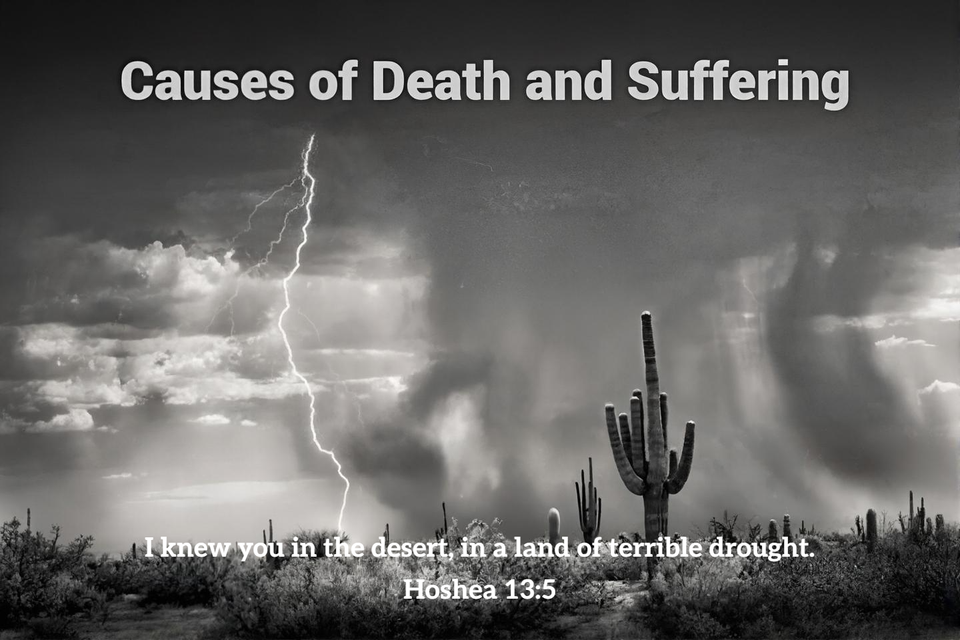
Every generation asks it—usually in grief, confusion, or anger: “If God is good, why do people die, and why do they suffer?”
As talmidim (disciples), we don’t answer with slogans. We answer with TORAH (His instructions, all of Scripture—Tanakh and Brit HaDashah), and with the compassion and truth of our Rabbi HaGadol Y’hoshua ben Y’hovah, who never dismissed suffering, but also never excused wickedness.
This teaching offers a scriptural framework that is honest, balanced, and pastoral: Yes, suffering often comes from human wickedness and free will, but Scripture also speaks of a fallen world, consequences, spiritual warfare, and even righteous suffering that refines.
And no—this is not a “blame the victim” teaching. That kind of comfort is like handing someone a rock and calling it manna.
Foundational guardrail: not all suffering is personal sin
The Scriptures reject the simplistic idea that the victim’s personal sin causes every tragedy.
“Neither this man nor his parents sinned…” — Yochanan [John] 9:3 (CJB)
And when Y’hoshua was told about a horrific tragedy, He didn’t say the victims “deserved it.” He called the living to repentance rather than condemning the dead.
Just then, some people came to tell Yeshua about the men from the Galil whom Pilate had slaughtered even while they were slaughtering animals for sacrifice. His answer to them was, “Do you think that just because they died so horribly, these folks from the Galil were worse sinners than all the others from the Galil? No, I tell you. Rather, unless you turn to God from your sins, you will all die as they did! “Or what about those eighteen people who died when the tower at Shiloach fell on them? Do you think they were worse offenders than all the other people living in Yerushalayim? No, I tell you. Rather, unless you turn from your sins, you will all die similarly.”
— Luqas [Luke] 13:1–5 (CJB)
So we begin here:
Not all suffering is the direct result of a person’s personal sin—yet all suffering exists in a world damaged by sin.
Wickedness and Free Will (Qayin קַיִן & Hevel הֶבֶל)
A massive portion of suffering is caused by people harming people: violence, abuse, oppression, exploitation, corruption, betrayal. The Torah gives us the earliest and most sobering example: Cain (קַיִן, Qayin) and Abel (הֶבֶל, Hevel).
In Berĕshith [Genesis] 4, both brothers bring offerings before Y'hovah. When Qayin becomes angry that his offering is not regarded as Hevel’s, YHVH speaks to him directly—not distant, not silent, not absent. He warns him, appeals to his conscience, and lays out a choice:
“Why are you angry? … If you do well, shall you not be uplifted? And if you do not do well, sin is crouching at the door… but you must rule over it.” — Berĕshith [Genesis] 4:6–7 (JPS Tanakh)
This is crucial for our subject: YHVH/God was there. He confronted the inner condition of Qayin’s heart, and He gave a clear instruction: master the sin; don’t let it master you.
Yet Qayin chose otherwise.
“And Qayin spoke to Hevel his brother… and it came to be… that Qayin rose up against Hevel his brother and killed him.”
— Berĕshith [Genesis] 4:8 (TS2009)
Y'hovah then exposes the crime and declares that the blood itself testifies:
“The voice of your brother’s blood cries out to Me from the ground.” — Berĕshith [Genesis] 4:10 (JPS Tanakh)
Here is the hard lesson: God did not stop the murder, even though He was present and even though He warned Qayin beforehand. Why? Because this is what true free will looks like in a moral universe: Y'hovah created humans with real agency, and real agency means people can choose wickedness—even after divine warning.
When Y'hovah said, “sin is crouching at the door… but you must rule over it,” He revealed that the battle for evil often happens before the act (in the mind) at the level of desire, jealousy, anger, and refusal to be corrected.
The Torah also shows another truth alongside free will: accountability and consequences. Qayin is judged, cursed from the ground, and driven into instability (Berĕshith [Genesis] 4:11–12). Yet even within judgment, Y'hovah shows restraint/mercy by placing a protective mark on Qayin so he is not immediately killed in retaliation (Berĕshith [Genesis] 4:15).
Key point: Qayin and Hevel reveal the anatomy of suffering:
- Wickedness begins in the mind and then is entrenched in the heart (anger, jealousy, rejection of correction).
“The heart is more deceitful than anything else and mortally sick. Who can fathom it? I, ADONAI, search the heart; I test inner motivations; in order to give to everyone what his actions and conduct deserve.”
Yirmeyahu (Jeremiah) 17:9-10 CJB
- YHVH warns and calls the sinner to master sin.
- The person can still choose murder (free will).
- Judgment follows (consequences).
- And even then, Y'hovah remains sovereign—just, present, and purposeful.
So when we ask, “Where was God?” in the face of human evil, the Torah answers:
Y'hovah was there—warning, witnessing, judging—yet not overriding the free will choice.
A fallen world — creation itself is broken
Not all suffering is caused by someone’s direct wickedness. Some pain comes from living in a world that is not Eden anymore: decay, disease, disasters, aging, death.
“The creation has been groaning…” — Romiyim [Romans] 8:22 (CJB)
Creation is beautiful, but fractured, broken, from man's choice to sin. That “groaning” explains why some suffering feels unpredictable. It is not that Y’hovah is blind—it is that the world is not yet fully restored.
Consequences — sowing and reaping are real
Sometimes suffering is not “punishment” in a courtroom sense; it is cause-and-effect. Reject wisdom, and damage follows.
“There is a way which seems right… but its end is the way to death.”
Mishlĕ [Proverbs] 14:12 (JPS Tanakh)
In the Torah, particularly in the book of Deuteronomy, blessings are promised to those who obey YHVH's commandments, leading to prosperity and well-being, while curses are warned for those who disobey, resulting in misfortune and suffering. This duality emphasizes the importance of faithfulness to the covenant with Y'hovah and the consequences of one's actions.
TORAH’s instructions are protective. When they’re ignored, wounds multiply—often to the person and to others around them.
Spiritual warfare — the enemy seeks to destroy
Scripture also acknowledges spiritual opposition.
“…our struggle is not against flesh and blood…” — Ephesiyim [Ephesians] 6:12 (CJB)
And Y’hoshua summarizes the enemy’s intent:
“The thief comes only to steal, kill and destroy…” — Yochanan [John] 10:10 (CJB)
We stay balanced: not paranoid, not naïve. We resist the enemy by the power of Ruach HaKodesh while obeying Torah and walking in truth.
Righteous suffering — testing, refinement, and discipline
Some suffering comes because someone is faithful, or because Y’hovah is forming maturity.
“Do not be surprised… as though something strange were happening…” — Kefa Aleph [1 Peter] 4:12 (CJB)
“For the moment all discipline seems painful…” — Ivrim [Hebrews] 12:11 (CJB)
Refinement is not condemnation. It is the loving work of a Father shaping a son.
So I went down to the house of the potter; and there he was, working at the wheels. Whenever a pot he made came out imperfect, the potter took the clay and made another pot with it, in whatever shape suited him. Then the word of ADONAI came to me: “House of Isra’el, can’t I deal with you as the potter deals with his clay?—says ADONAI. Look! You, house of Isra’el, are the same in my hand as the clay in the potter’s hand.
Yirmeyahu (Jeremiah) 18:3-6 (CJB)
Iyov [Job]: when neat answers collapse
Iyov shows us that suffering is sometimes deeper than our formulas. His friends spoke confidently—and were corrected by Y’hovah. The lesson is humility: sometimes the right response is not explanation, but reverence and faithfulness.
How should a talmid (disciple) respond when suffering hits?
This is where teaching becomes discipleship:
1) Refuse accusations and shortcuts
Don’t rush to blame the sufferer (Yochanan [John] 9). Don’t minimize pain with slogans.
2) Run to Y’hovah, not away
“YHVH is close to the brokenhearted…” — Tehillim [Psalms] 34:18 (JPS Tanakh)
3) Do the next right step of TORAH
Pray. Repent where conviction is absolute. Be filled with the power of the Ruach HaKodesh. Make restitution where needed. Seek wise counsel by following TORAH. Guard the tongue. Help the oppressed.
4) Become part of the solution
Many suffer because of wickedness. TORAH doesn’t only explain suffering—it commands us to confront it through justice, mercy, and truth. Start with being born again, then a lifetime of discipleship.
“…do justice, love kindness…” — Mikhah [Micah] 6:8 (JPS Tanakh)
5) Hold to the hope of restoration
The story does not end at the grave.
“…He shall wipe away every tear…” — Ḥazon [Revelation] 21:4 (TS2009)
Conclusion: the framework TORAH gives us
Death and suffering exist because:
- Wickedness is real, and humans choose it (Qayin and Hevel).
- Free will is real, and YHVH does not override the free will choice, even when He warns.
- Curses for not following the Torah (Deut. 27) are real
- A fallen world groans under corruption and decay.
- Consequences follow choices.
- Spiritual warfare opposes the purposes of Elohim.
- Righteous suffering can refine the set-apart ones.
And above all:
Y’hovah is not indifferent.
He is near the broken and suffering. He is with us even in our desert of death and affliction. He acts justly against the wicked. He is faithful to His covenants with His people, disciples, and remnant. We are victorious through His Word, Ruach HaKodesh, even our Rabbi HaGadol Y’hoshua ben Y’hovah, who is coming soon. We, His bride (Yisrael), look to our marriage, to the Lamb (who takes away our sins).
By Rabbi Francisco Arbas
📧 franciscoarbas.yisrael@gmail.com
Following His ‘WAY’ — Netzari Mashiach Judaism
Wherewithal shall a young man keep his way pure?
By taking heed thereto according to Thy word.
With my whole heart have I sought Thee; O let me not err from Thy commandments. Thy word have I laid up in my heart, that I might not sin against Thee. Blessed art Thou, O LORD; teach me Thy statutes. With my lips have I told all the ordinances of Thy mouth. I have rejoiced in the way of Thy testimonies, as much as in all riches. I will meditate in Thy precepts, and have respect unto Thy ways. I will delight myself in Thy statutes; I will not forget Thy word.
Tehillim (Psalms) 119:10-16 (JPS Tanakh)

Comments ()