Does the New Covenant Violate Deuteronomy 4:2?
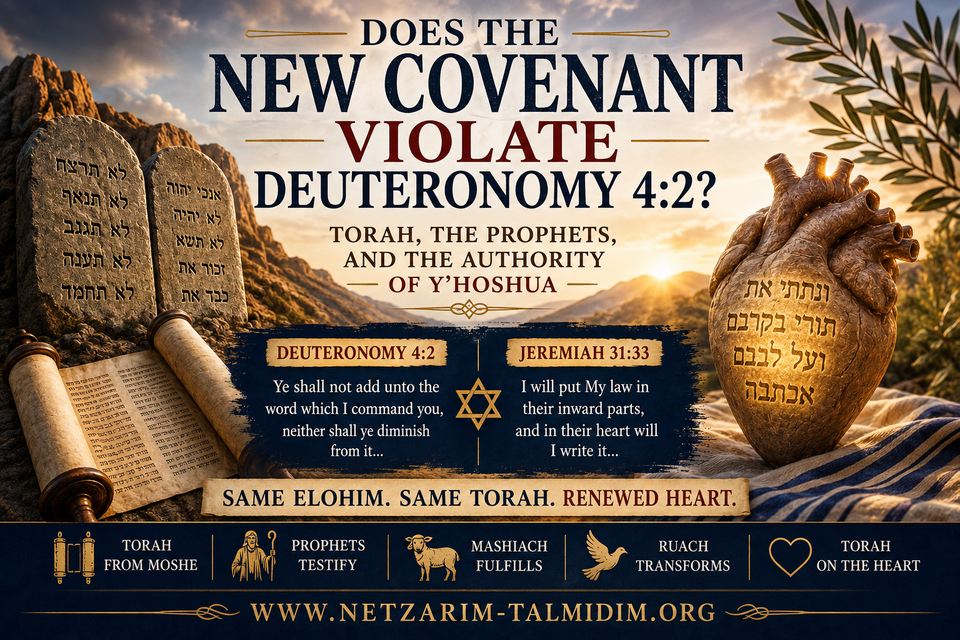
Torah, the Prophets, and the Authority of Y’hoshua
One of the most serious objections raised against faith in Y’hoshua HaMashiach and the New Covenant writings comes directly from the Torah.
Moshe warned Yisrael:
“Ye shall not add unto the word which I command you, neither shall ye diminish from it, that ye may keep the commandments of Y’hovah your Elohim which I command you.”
— Devarim (Deuteronomy) 4:2, JPS 1917
Likewise, Mishlei declares:
“Every word of God is tried; He is a shield unto them that take refuge in Him. Add thou not unto His words, lest He reprove thee, and thou be found a liar.”
— Mishlei (Proverbs) 30:5–6, JPS 1917
The objection therefore sounds reasonable:
If Y’hovah commanded Yisrael not to add to the Torah given through Moshe, how can we accept writings that came centuries later and call them Scripture?
Furthermore, if Yeshua/Jesus brought a “New Covenant,” does that mean He replaced, corrected, or abolished the covenantal revelation given through Moshe?
These are legitimate questions. And they deserve a Scriptural answer. As Netzari followers of Rabbi Y’hoshua, we should not attempt to weaken Devarim 4:2.
We affirm it.
No prophet, rabbi, apostle, council, denomination, religious institution, or human tradition possesses authority to add commandments to Y’hovah's Word or remove commandments from it.
But Devarim 4:2 does not say that Y’hovah Himself would never speak again.
In fact, the Torah teaches exactly the opposite.
What Does “Do Not Add or Take Away” Mean?
We must first allow Moshe's words to speak within their context. Devarim 4:1–2 concerns obedience to the commandments Y’hovah gave Yisrael. Moshe was warning the people not to alter what Y’hovah had commanded.
The same principle appears later:
“All this word which I command you, that shall ye observe to do; thou shalt not add thereto, nor diminish from it.”
— Devarim (Deuteronomy) 13:1 [12:32 in many English Bibles], JPS 1917
The prohibition concerns tampering with Y’hovah's commandments.
Man cannot decide: “Y’hovah forgot something, so we need to add another commandment.” Neither can man say: “That commandment is inconvenient today, so we will remove it.”
Y’hovah alone is the Lawgiver. The Torah must not be rewritten according to human preference.
That principle remains true.
If Deuteronomy 4:2 Ended Revelation, Much of the Tanakh Would Have to Be Rejected
Here we encounter an immediate difficulty with interpreting Devarim 4:2 as meaning:
“Nothing revealed after Moshe can be Scripture.”
If that interpretation were correct, then what would we do with the rest of the Tanakh?
After Moshe came Yehoshua. Then the Judges. Then Shmuel. Then David. Then Shlomo. Then Yeshayahu. Yirmeyahu. Yechezkel. Daniel. And the Twelve Prophets.
The Psalms, Proverbs, and other writings were also received and preserved within Yisrael.
Yet these writings came after the Torah of Moshe.
Orthodox Judaism itself does not regard Yeshayahu or Yirmeyahu as unlawful additions to Torah.
Why?
Because there is a difference between: man adding to Y’hovah's commandments and Y’hovah continuing to reveal His will through prophets whom He appoints.
That distinction is essential. And remarkably, Moshe himself established it.
The Torah Predicts Revelation After Moshe
Moshe told Yisrael:
“A prophet will Y’hovah thy Elohim raise up unto thee, from the midst of thee, of thy brethren, like unto me; unto him ye shall hearken.”
— Devarim (Deuteronomy) 18:15, JPS 1917
Y’hovah then declared:
“I will raise them up a prophet from among their brethren, like unto thee; and I will put My words in his mouth, and he shall speak unto them all that I shall command him.”
— Devarim 18:18, JPS 1917
And then comes a very serious warning:
“And it shall come to pass, that whosoever will not hearken unto My words which he shall speak in My name, I will require it of him.”
— Devarim 18:19, JPS 1917
Notice what Y’hovah says: “I will put My words in his mouth.”
Therefore Devarim 4 and Devarim 18 cannot contradict each other. Devarim 4 says: Do not alter what Y’hovah has spoken.
Devarim 18 says: Y’hovah will continue speaking through prophets whom He raises up.
Consequently, the question cannot simply be: “Did this revelation come after Moshe?” If that were the standard, Yisrael would have to reject virtually every prophet after Moshe.
The proper question is: “Did Y’hovah truly speak through this person?”
And that brings us to another important passage.
Torah Gives Us a Test for Prophets
The Torah does not instruct Yisrael to reject every prophet who comes after Moshe. Instead, Torah teaches Yisrael how to test prophets. Devarim 13 warns that even signs and wonders do not validate someone who leads Yisrael away from Y’hovah.
“Thou shalt not hearken unto the words of that prophet... for Y’hovah your Elohim putteth you to proof, to know whether ye do love Y’hovah your Elohim with all your heart and with all your soul.”
— Devarim (Deuteronomy) 13:4 [13:3], JPS 1917
Then Moshe gives the standard:
“After Y’hovah your Elohim shall ye walk, and Him shall ye fear, and His commandments shall ye keep, and unto His voice shall ye hearken, and Him shall ye serve, and unto Him shall ye cleave.”
— Devarim 13:5 [13:4], JPS 1917
This gives us an extraordinarily important principle. If Y’hoshua taught Yisrael: “Abandon Y’hovah.”
Then reject Him, reject His commandments, worship foreign gods, and forget Torah.
So according to Torah itself, Yisrael should reject Y’hoshua.
We should have no difficulty saying this. But is that what Rabbi Y’hoshua actually taught?
No. Quite the opposite.
Y’hoshua Affirmed the Shema
When asked which commandment was foremost, Y’hoshua answered from Torah:
“The most important is, ‘Sh’ma Yisra’el, ADONAI Eloheinu, ADONAI echad [Hear, O Isra’el, the LORD our God, the LORD is one], and you are to love ADONAI your God with all your heart, with all your soul, with all your understanding and with all your strength."
— Mark 12:29–30, CJB
Rabbi Y’hoshua did not redirect Yisrael toward another Elohim. He directed Yisrael back to the Shema.
Hear, O Yisrael: Y’hovah our Elohim, Y’hovah is one.
That is not rebellion against Moshe. That is fidelity to Moshe.
Y’hoshua Explicitly Denied Abolishing Torah
Perhaps no statement is clearer than Rabbi Y’hoshua's words in the Sermon on the Mount:
“Don't think that I have come to abolish the Torah or the Prophets. I have come not to abolish but to complete.”
— Mattityahu (Matthew) 5:17, CJB
Then He strengthens the statement:
“Yes indeed! I tell you that until heaven and earth pass away, not so much as a yud or a stroke will pass from the Torah — not until everything that must happen has happened.”
— Mattityahu 5:18, CJB
Then comes something particularly relevant to Devarim 4:2:
“So whoever disobeys the least of these mitzvot and teaches others to do so will be called the least in the Kingdom of Heaven.”
— Mattityahu 5:19, CJB
Think carefully about this. The accusation is that Y’hoshua undermined Torah.
Yet the recorded teaching of Y’hoshua warns His own talmidim against loosening the commandments. That deserves serious consideration.
Y’hoshua Condemned Adding Human Tradition to Y’hovah's Commandments
There is another fascinating connection with Devarim 4:2.
Y’hoshua criticized religious authorities when human tradition was allowed to override Y’hovah's commandments.
Quoting Yeshayahu, He said:
“Their worship of me is useless, because they teach man-made rules as if they were doctrines.”
— Mattityahu (Matthew) 15:9, CJB
Then He declared:
“Thus by your tradition you make null and void the word of God!”
— Mattityahu 15:6, CJB
Y’hoshua's concern, therefore, mirrors that of Devarim 4:2.
Do not replace the commandments of Y’hovah with the commandments of men.
The problem was not Torah. The problem was allowing human authority to stand above the Word of Y’hovah. That remains a danger in every religious community.
No tradition should be permitted to nullify the written TORAH.
The “New Covenant” Was Not Invented by Christianity
This may be the most important point in the entire discussion.
Some hear the phrase “New Covenant” and immediately think:
Christianity. . Church. . Rome. . Constantine. . New Testament.
But the term existed long before Christianity. The promise comes directly from the Jewish prophet Yirmeyahu.
“Behold, the days come, saith Y’hovah, that I will make a new covenant with the house of Israel, and with the house of Judah.”
— Yirmeyahu (Jeremiah) 31:31, JPS 1917
Notice carefully who receives this covenant. Y’hovah does not say: “I will make a New Covenant with Rome or Christianity.”
Nor: “With any Gentile institution replacing Yisrael.”
He says: “With the house of Israel, and with the house of Judah.” Brit Chadashah—the New Covenant—is fundamentally a Jewish covenant promise.
Does the New Covenant Abolish Torah?
Yirmeyahu answers this question for us. What does Y’hovah do under this promised covenant?
“But this is the covenant that I will make with the house of Israel after those days, saith Y’hovah, I will put My law in their inward parts, and in their heart will I write it; and I will be their Elohim, and they shall be My people.”
— Yirmeyahu 31:33, JPS 1917
This is critical. Y’hovah does not say: “I will remove My Torah.” He says: “I will put My Torah within them.”
He does not say: “My commandments will become irrelevant.” He says: “I will write them upon their hearts.”
Therefore, the prophetic New Covenant cannot properly be understood as: Torah abolished. But it is: Torah internalized. The movement of the WAY is not from Torah to lawlessness. It is from commandments merely written externally to Y’hovah's instruction being written upon the heart.
Yechezkel Describes the Same Restoration
The prophet Yechezkel describes a similar work:
“A new heart also will I give you, and a new spirit will I put within you... And I will put My spirit within you, and cause you to walk in My statutes, and ye shall keep Mine ordinances, and do them.”
— Yechezkel (Ezekiel) 36:26–27, JPS 1917
Notice the result of receiving Y’hovah's Ruach. It is not: “Now you no longer need My statutes.” Rather: “I will... cause you to walk in My statutes.”
This is profoundly important for understanding the Ruach HaKodesh (Holy Spirit). The Ruach was never given to produce rebellion against Torah. The Ruach empowers covenant faithfulness. The renewed heart and the Torah walk belong together.
Moshe Himself Foretold Circumcision of the Heart
Even this idea does not begin in the New Covenant writings. Moshe said:
“And Y’hovah thy Elohim will circumcise thy heart, and the heart of thy seed, to love Y’hovah thy Elohim with all thy heart, and with all thy soul, that thou mayest live.”
— Devarim (Deuteronomy) 30:6, JPS 1917
Therefore we see a beautiful progression already within the Tanakh:
Moshe — circumcision of the heart.
Yirmeyahu — Torah written upon the heart.
Yechezkel — a new heart and Ruach producing obedience.
These are not foreign ideas imposed upon Judaism centuries later. They arise from the Torah and the Prophets themselves.
What Exactly Is “New” About the New Covenant?
Here we need precision. “New” does not mean that Y’hovah suddenly became a different Elohim. It does not mean righteousness became unrighteousness. It does not mean holiness became irrelevant. It does not mean sin stopped being sin.
And it certainly does not mean Y’hovah discovered that Torah was defective.
The problem was never Y’hovah's instruction. The problem is the human heart. Yirmeyahu describes Yisrael's breaking of the covenant (Jeremiah 31:32).
Therefore, Y’hovah promises transformation from within. This is why the New Covenant must be understood within the larger prophetic expectation of restoration.
The covenant people require renewed hearts.
Forgiveness, cleansing, Ruach, and reconciliation with Y’hovah.
Y’hoshua Identifies His Mission With That New Covenant
At His final Passover meal with His talmidim, Y’hoshua took the cup and declared:
“This cup is the New Covenant, ratified by my blood, which is being poured out for you.”
— Luke 22:20, CJB
This statement cannot properly be understood apart from Yirmeyahu 31.
Y’hoshua was not inventing the concept of a New Covenant. He was identifying His approaching death with Y’hovah's already-promised covenant restoration.
That means the question becomes: Is Y’hoshua truly the One through whom Y’hovah brings the promised covenant? Now we are discussing the real issue.
The Question Is Not “New Testament or Torah?”
This false choice has caused enormous confusion. People are often presented with two options:
Torah OR Y’hoshua.
Moshe OR Mashiach.
Old Testament OR New Testament.
But Y’hoshua Himself said:
“For if you really believed Moshe, you would believe me; because it was about me that he wrote.”
— Yochanan (John) 5:46, CJB
From the Netzari perspective, Moshe and Mashiach are not enemies.
Moshe points forward. The Prophets expand the expectation. Mashiach fulfills the mission Y’hovah appointed Him to accomplish. And Mashiach points everyone back to the Father.
The Scriptural movement is therefore:
Torah → Prophets → Mashiach → Restoration.
Not: Torah → Mashiach → Torah abolished.
What About Sha’ul?
At this point someone may object: “Perhaps Y’hoshua respected Torah, but Sha’ul abolished it.”
That question deserves its own full teaching, but we should notice something Sha’ul says plainly:
“Does it follow that we abolish Torah by this trusting? Heaven forbid! On the contrary, we confirm Torah.”
— Romans 3:31, CJB
Sha’ul's writings can be difficult. Kefa himself acknowledged this:
“He writes the same way in all his letters... Some things in them are hard to understand...”
— 2 Kefa (2 Peter) 3:16, CJB
Unfortunately, difficult passages have sometimes been interpreted as though Sha’ul taught lawlessness. But Sha’ul himself denies that conclusion.
Therefore, difficult statements should be interpreted in light of clear statements—not the clear statements overturned because of difficult ones.
The New Covenant Writings Must Still Be Tested
Netzari faith should never require blind acceptance. The Bereans provide our model:
“Now the people here were of nobler character than the ones in Thessalonica; they eagerly welcomed the message, checking the Tanakh every day to see if the things Sha’ul was saying were true.”
— Acts 17:11, CJB
Notice what they did. They did not possess a completed “New Testament” with which to test Sha’ul. They searched the Tanakh.
That is profoundly Netzari. If our interpretation of Y’hoshua contradicts the Torah and the Prophets, something is wrong with our interpretation. If our interpretation of Sha’ul contradicts Y’hoshua, something is wrong with our interpretation. The entire witness must remain harmonious.
What About Proverbs 30:5–6?
Let us return to the second passage often raised:
“Every word of God is tried... Add thou not unto His words, lest He reprove thee, and thou be found a liar.”
— Mishlei 30:5–6, JPS 1917
We agree. But notice something simple. Proverbs itself came after the Torah.
If “add thou not unto His words” meant that Y’hovah could never inspire another word of Scripture, then the statement would undermine the very book containing it.
That cannot be its meaning. The warning is against human beings adding their own words and presenting them as Y’hovah's authority. The principle protects revelation from human corruption. It does not silence Y’hovah.
The Same Warning Appears at the End of Revelation
Interestingly, the New Covenant writings conclude with a remarkably similar warning:
“I warn everyone hearing the words of the prophecy in this book that if anyone adds to them, God will add to him the plagues written in this book. And if anyone takes anything away from the words in the book of this prophecy, God will take away his share...”
— Revelation 22:18–19, CJB
The principle running throughout Scripture is consistent: Man does not possess authority to rewrite the Word of Y’hovah.
Devarim, Mishlei, and Revelation says it. The New Covenant writings do not reject that principle. They repeat it.
The Real Question Concerning Y’hoshua
We can now identify the actual disagreement. The question is not: “Can Y’hovah speak after Moshe?”
The Tanakh already proves that He did. The question is not: “Can there be a New Covenant?” Yirmeyahu explicitly says there will be. The question is not: “Will Y’hovah transform the heart through His Ruach?”
Moshe, Yirmeyahu, and Yechezkel already anticipate it. Therefore the central question becomes:
Is Y’hoshua the promised Mashiach of Yisrael?
That question must be examined through Scripture.
Does He correspond to the prophetic witness? Does He lead people toward Y’hovah or away from Him? Does He honor Torah or despise it? Does His mission correspond with Y’hovah's promises of redemption, forgiveness, restoration, covenant renewal, and the coming Kingdom?
Those are legitimate questions. And those are the questions we should invite our Jewish brothers and sisters to investigate.
A Challenge to Christianity as Well
There is another side to this teaching that we should not ignore. Devarim 4:2 does not merely challenge Orthodox Jewish objections to the New Covenant.
It also challenges Christianity. If Christians claim that Y’hoshua abolished commandments that Y’hovah commanded... If they portray Moshe as the enemy of grace... If they teach that obedience to Y’hovah's instructions is somehow contrary to faith...
If they turn Y’hoshua into the founder of a new religion detached from Yisrael... Then our Jewish brothers have understandable reasons for questioning that presentation of “Jesus.”
For centuries, much of Christianity has presented Jesus in ways that make Him appear opposed to the Torah He Himself affirmed.
The Netzari answer is not to defend every later Christian tradition. It is to return to the Jewish Rabbi from Nazareth, Y'hoshua/Yeshua.
Rabbi Y’hoshua did not come to establish rebellion against His Father's Word. He came as Mashiach (Messiah) of Yisrael.
Torah and Mashiach Belong Together
Y’hoshua said:
“If you love me, you will keep my commands.”
— Yochanan (John) 14:15, CJB
And Yochanan later describes the faithful:
“This is how we know that we love God's children: when we love God, we also do what he commands. For loving God means obeying his commands. Moreover, his commands are not burdensome.”
— 1 Yochanan (1 John) 5:2–3, CJB
Revelation describes the perseverance of the holy ones:
“Here is the perseverance of the saints, those who keep the commandments of God, and the faith of Yeshua.”
— Revelation 14:12, WEB
Notice the combination: The commandments of Y’hovah. The faith of Y’hoshua. Not one against the other. Together.
From Stone to Heart
Perhaps this is the simplest way to understand the New Covenant. Y’hovah did not promise: “I will eliminate My Torah.”
He promised: “I will write it upon their hearts.” The destination of Torah was always deeper than ink upon parchment. Y’hovah desires a people who love Him:
“with all thy heart, and with all thy soul, and with all thy might.”
— Devarim 6:5, JPS 1917
External obedience without a transformed heart can become mere religion. But a claimed transformed heart without obedience can become lawlessness. The Scriptural path joins the two:
Torah within. . Ruach within. . Love within. . Obedience expressed outwardly.
This is Covenant Relationship.
Not empty religion,
Our Answer to the Orthodox Jewish Objection
So when someone says: “I cannot accept the New Covenant because Deuteronomy 4:2 says not to add to the Torah,”
Our response should be respectful: We agree that no human being may add to or subtract from Y’hovah's Torah.
But Devarim 4:2 cannot mean Y’hovah stopped speaking after Moshe, because the Torah itself establishes the prophetic office, and Judaism accepts the Prophets and Writings that came after Moshe. Furthermore, the “New Covenant” was not invented by Christianity. Y’hovah Himself promised it through Yirmeyahu:
“I will make a new covenant with the house of Israel, and with the house of Judah.”
And what happens under that covenant?
“I will put My law in their inward parts, and in their heart will I write it.”
Therefore the New Covenant, properly understood, does not announce the destruction of Torah. It announces Torah written upon transformed hearts.
The real question is therefore not whether a New Covenant is Scriptural.
The Tanakh says it is.
The question is whether Rabbi Y’hoshua of Nazareth is the promised Mashiach through whom that covenant is established. That question deserves to be investigated from the Torah and the Prophets.
Conclusion — Do Not Add. Do Not Take Away. Listen to Y’hovah.
Devarim 4:2 remains true. Do not add. Do not diminish.
Do not replace Y’hovah's commandments with human commandments.
Do not allow religious tradition to nullify His Word.
But neither should we use Devarim 4:2 to prevent Y’hovah from doing something He already said He would do.
He promised prophets, Mashiach, restoration, and cleansing.
He promised His Ruach, transformed hearts, and through Yirmeyahu He explicitly promised: A NEW COVENANT.
Not with Roman Christianity. Not as a rejection of Yisrael. But: “with the house of Israel, and with the house of Judah.” And the Torah would not disappear. Y’hovah said:
“I will put My law in their inward parts, and in their heart will I write it.”
This is why Netzari Mashiach Judaism does not see Torah and the New Covenant as enemies. We see one continuous redemptive revelation: Moshe points forward. The Prophets testify. The New Covenant is promised.
Mashiach comes. The Ruach transforms. Torah is written upon the heart.
And the people of Y’hovah learn to walk in His WAY.
“After Y’hovah your Elohim shall ye walk, and Him shall ye fear, and His commandments shall ye keep, and unto His voice shall ye hearken, and Him shall ye serve, and unto Him shall ye cleave.”
— Devarim 13:5 [13:4], JPS 1917
The New Covenant does not call us away from the Elohim of Moshe. It calls us into the covenant restoration that the Elohim of Moshe promised.
By Francisco Arbas
📜Email: rabbi@netzarim-talmidim.org
Following His ‘WAY’ ✡︎ Netzari Mashiach Judaism
Comments ()