Eating According to the Torah of Y’hovah.
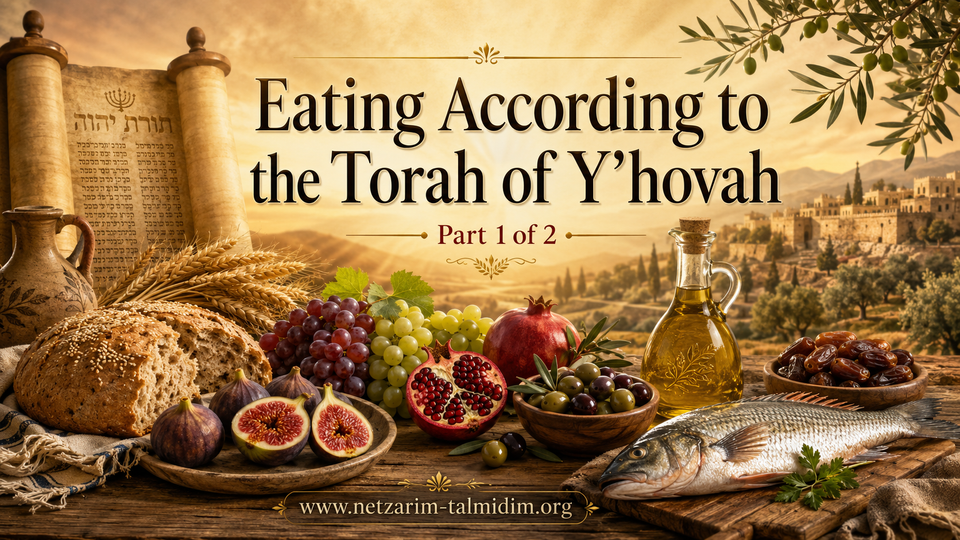
Food, Holiness, and Clean Discernment
Food Is Covenant
In the Scriptures, food is never merely physical.
From Gan Eden to Noach, from Sinai to the wilderness, from the table of Y’hoshua to the fellowship meals of the early talmidim, food has always carried covenant meaning.
What we eat, how we eat, and whether we receive Y’hovah’s instructions with humility reveals much about the condition of the heart.
For the talmid of Y’hoshua, the table is not separated from discipleship. The table becomes one of the daily places where faith is practiced, obedience is tested, gratitude is expressed, and holiness is lived.
Y’hovah does not only claim the synagogue, the study room, or the prayer closet.
He also claims the table.
“Therefore, consecrate yourselves; you people must be holy, because I am holy.”
— Vayikra (Leviticus) 11:44, CJB
The CJB renders the covenant Name as “ADONAI.” In this teaching, we identify Him by His covenant Name: Y’hovah.
The call is simple: because Y’hovah is holy, His people must learn to live holy—even in ordinary daily choices such as eating and drinking.
Food Was Given as Provision, Not Indulgence
In the beginning, food was given as a gift from the Creator.
Y’hovah gave Adam and Chavah seed-bearing plants and fruit-bearing trees for nourishment. Food was provision, not indulgence. It was received from the hand of the Father with gratitude and responsibility.
“I have given you every seed-bearing plant... and every tree with seed-bearing fruit.”
— B’resheet (Genesis) 1:29, CJB
Food began as blessing.
But even in Gan Eden, food was connected to obedience. There was what could be eaten, and there was what could not be eaten. The first test of mankind involved whether human beings would trust Y’hovah’s command or follow the voice of another.
This is important.
The appetite was one of the first places where obedience was tested.
It remains one of the first places where discipleship must be restored.
Clean and Unclean Before Sinai
Many assume that clean and unclean distinctions began with Mosheh at Sinai. Scripture shows otherwise.
Before the flood, Noach already understood the difference between clean and unclean animals.
“Of every clean animal you are to take seven couples... and of the animals that are not clean, one couple.”
— B’resheet (Genesis) 7:2, CJB
This was long before Sinai.
Therefore, the distinction between clean and unclean was not invented by rabbinic Judaism, later Jewish tradition, or even by Mosheh himself. These distinctions existed within Y’hovah’s order of creation.
Sinai did not invent holiness.
Sinai revealed, clarified, and covenantally instructed Yisrael in the holiness of Y’hovah.
The Torah teaches us how to discern between the clean and the unclean, the holy and the common, the permitted and the forbidden.
The Torah’s Purpose in Food Instructions
The food instructions in the Torah are not random restrictions.
They are part of Y’hovah’s training in holiness.
“For you are a people set apart as holy for ADONAI your God.”
— D’varim (Deuteronomy) 14:2, CJB
Y’hovah’s people are not called to live like the nations. We are not called to eat without discernment, consume without thanksgiving, or treat the body as if it belongs to us.
The Torah teaches that every part of life belongs to Y’hovah.
Our worship belongs to Him.
Our time belongs to Him.
Our families belong to Him.
Our bodies belong to Him.
And yes, our table belongs to Him.
Eating according to the Torah is not about earning salvation. Salvation is by the mercy of Y’hovah through the redemptive work of Y’hoshua HaMashiach.
But obedience is the fruit of redemption.
We do not obey to become loved.
We obey because we are loved, redeemed, instructed, and set apart.
Clean Land Animals
The Torah gives clear instruction concerning land animals.
“Any that has a separate hoof which is completely divided and chews the cud—these animals you may eat.”
— Vayikra (Leviticus) 11:3, CJB
Clean land animals must have both signs:
They must chew the cud.
They must have a divided hoof.
Animals such as cattle, sheep, goats, and deer meet this standard.
Animals such as pigs, camels, rabbits, and other animals that lack one or both signs are not clean for food.
The pig is specifically important because many believers today assume that Y’hoshua made pork acceptable. But the Torah is clear. The pig has a split hoof but does not chew the cud, and therefore it is unclean.
“The pig... is unclean for you.”
— D’varim (Deuteronomy) 14:8, CJB
This is not a small matter.
Y’hovah did not call the pig unclean because of human opinion. He called it unclean by His own authority.
The talmid of Y’hoshua must ask a simple question:
Who has the right to define what is clean—Y’hovah or man?
Clean Fish
The Torah also gives clear instruction concerning creatures from the waters.
“You may eat whatever has fins and scales.”
— D’varim (Deuteronomy) 14:9, CJB
Clean fish must have both fins and scales.
Examples include fish such as salmon, tuna, cod, snapper, and trout.
Unclean water creatures include shrimp, crab, lobster, clams, oysters, catfish, eel, squid, and other creatures lacking fins and scales.
Again, this is not merely about health.
It is about discernment.
Y’hovah’s people are trained to ask, “Has my Father permitted this?”
The world says, “Eat whatever you want.”
The Torah says, “Eat what Y’hovah has called clean.”
Birds, Creeping Things, and the Pattern of Discernment
The Torah lists birds that are not to be eaten, and many of them are predators or scavengers.
“You are not to eat any detestable bird.”
— D’varim (Deuteronomy) 14:12, CJB
Unclean birds often feed on death, decay, or violence.
This teaches us a spiritual principle: Y’hovah’s people must not feed on death.
We must not develop an appetite for corruption, violence, uncleanness, or spiritual decay.
Even insects and creeping things are addressed in the Torah. Most are forbidden, though certain locusts are permitted.
“Those which have jointed legs... you may eat.”
— Vayikra (Leviticus) 11:21, CJB
Yochanan the Immerser ate locusts and wild honey in the wilderness. His diet was simple, separated, and consistent with Torah.
The lesson is not that insects are central to biblical eating. The lesson is that Y’hovah’s Word is precise, and His people must learn precision in obedience.
Holiness Is Not Legalism
One of the greatest misunderstandings in modern religion is the idea that obedience equals legalism.
That is not biblical.
Legalism is when man attempts to earn salvation by works, or when man-made rules are elevated to divine authority.
Obedience is the loving response of a redeemed heart to the commandments of Y’hovah.
Y’hoshua said:
“If you love me, you will keep my commands.”
— Yochanan (John) 14:15, CJB
This is not bondage.
This is covenant love.
A husband who honors his marriage covenant is not in bondage to his wife.
A child who honors his father is not practicing legalism.
A talmid who honors Y’hovah’s food instructions is not trying to buy salvation.
He is simply learning to walk as a child of the Father.
Y’hoshua Did Not Abolish the Torah of Food
Many believers have been taught that Y’hoshua abolished the dietary instructions of the Torah. But Y’hoshua Himself said otherwise.
“Don’t think that I have come to abolish the Torah or the Prophets.”
— Mattityahu (Matthew) 5:17, CJB
Y’hoshua did not abolish the Torah.
He fulfilled it.
To fulfill does not mean to cancel. It means to bring to fullness, to live perfectly, to reveal the true meaning, and to accomplish what was promised.
Y’hoshua lived as a Torah-observant Jew. He never ate pork. He never ate shellfish. He never taught His talmidim to rebel against the Torah of His Father.
He is the Living TORAH, the Dabar made flesh. He shows us what perfect obedience looks like.
Mark 7: The Real Issue Was Tradition, Not Pork
Mark 7 is often used to claim that Y’hoshua declared all animals clean. But the context shows something very different.
The issue was not pork, shellfish, or unclean animals.
The issue was ritual handwashing according to the tradition of the elders.
The Pharisees and some Torah teachers criticized Y’hoshua’s talmidim because they ate with hands considered ritually unwashed according to man-made tradition.
Y’hoshua answered them sharply:
“You depart from God’s command and hold onto human tradition.”
— Mark 7:8, CJB
Here the CJB uses “God.” In our Netzari Mashiach Judaism language, we understand this as the command of Elohim—Y’hovah Himself.
Y’hoshua was not correcting the Torah.
He was correcting human tradition that had been placed above the Torah.
His point was that defilement is not created by failing to perform man-made handwashing rituals. True defilement comes from the evil heart: wicked thoughts, immorality, theft, murder, greed, deceit, pride, and foolishness.
Y’hoshua was restoring the heart of Torah, not abolishing the commandments of Torah.
Acts 10: Kefa’s Vision Was About People, Not Food
Acts 10 is another passage often misunderstood.
Kefa saw a vision of unclean animals and heard a voice telling him to rise, kill, and eat. But Kefa refused.
This is very important.
Years after Y’hoshua’s resurrection, Kefa still had not understood Y’hoshua to have abolished the dietary laws.
Kefa said:
“I have never eaten food that was unclean or treif.”
— Ma’asei (Acts) 10:14, CJB
If Y’hoshua had already abolished the Torah’s food instructions, Kefa did not know it.
But the meaning of the vision is explained in the chapter itself. The vision was preparing Kefa to go to the house of Cornelius, a Gentile, without calling Gentile believers common or unclean.
Kefa later explains:
“God has shown me not to call any person common or unclean.”
— Ma’asei (Acts) 10:28, CJB
The vision was not about eating unclean animals.
It was about receiving people from the nations whom Y’hovah was cleansing through repentance, faith, immersion, and the Ruach HaKodesh.
Acts 10 does not cancel Leviticus 11.
Acts 10 rebukes prejudice and reveals that Y’hovah is calling talmidim from among the nations.
Acts 15: The Nations Begin Their Walk in Holiness
In Acts 15, the emissaries addressed Gentile believers coming into the faith.
They gave four foundational instructions:
“Abstain from what has been sacrificed to idols, from blood, from what is strangled and from fornication.”
— Ma’asei (Acts) 15:29, CJB
These were not the end of Torah learning.
They were the beginning.
The reason is given earlier in the same chapter:
“For from the earliest times, Moshe has had in every city those who proclaim him.”
— Ma’asei (Acts) 15:21, CJB
The Torah was read every Shabbat in the synagogues.
The nations were not being told to ignore Torah. They were being welcomed into a process of learning Torah.
The emissaries did not say, “You may now eat unclean things.”
They said to begin by turning away from idolatry, blood, strangled meat, and sexual immorality—foundational matters of covenant holiness.
From there, the talmidim would continue learning the way of Y’hovah.
Blood Is Forbidden
The Torah repeatedly forbids eating blood.
“For the life of a creature is in the blood.”
— Vayikra (Leviticus) 17:11, CJB
This instruction is repeated in Acts 15.
Blood belongs to Y’hovah because life belongs to Y’hovah.
Therefore, clean animals must be slaughtered properly and drained of blood. This is not a meaningless ritual. It is a confession that life is sacred and that atonement belongs to Y’hovah.
Y’hoshua’s blood is the blood of the Renewed Covenant.
We do not consume animal blood because we honor the life Y’hovah has given and the atoning blood of Mashiach.
Man’s Traditions Must Never Replace Y’hovah’s Commands
Netzari Mashiach Judaism honors the written TORAH above human tradition.
This does not mean every tradition is evil.
Some traditions are helpful.
Some customs may preserve memory, identity, and order.
But no tradition has authority to add to, subtract from, or overrule the written Word of Y’hovah.
“In order to obey the mitzvot of ADONAI your God... do not add to what I am saying.”
— D’varim (Deuteronomy) 4:2, CJB
The Torah gives us clean and unclean distinctions. Man has often added layers of extra requirements that go beyond what is written.
Examples include mandatory separation of meat and dairy dishes, required waiting periods between meat and dairy, or treating organizational kosher symbols as if they were commandments from Sinai.
These may be personal or community practices, but they are not equal to the written Torah.
The written command says:
“You are not to boil a young animal in its mother’s milk.”
— Sh’mot (Exodus) 23:19, CJB
This command forbids a specific practice. It should not be expanded into a burden that Y’hovah did not command.
We must be careful not to call something sin when Y’hovah did not call it sin.
We must also be careful not to call something clean when Y’hovah called it unclean.
Both errors are dangerous.
Clean Eating and the Body as a Temple
The body of the believer belongs to Y’hovah.
“Your body is a temple for the Ruach HaKodesh who lives inside you.”
— Qorintiyim Aleph (1 Corinthians) 6:19, CJB
If the Ruach HaKodesh dwells in us, then we cannot treat the body carelessly.
What we eat matters.
How we eat matters.
Why we eat matters.
Clean eating is not the whole of holiness, but it is part of holiness.
We cannot claim that Y’hovah has access to our heart while refusing Him access to our habits.
The talmid must learn to bring the whole life under the loving rule of Y’hovah.
Eating and Drinking to the Glory of Y’hovah
Sha’ul wrote:
“Whatever you do, do it all so as to bring glory to God.”
— Qorintiyim Aleph (1 Corinthians) 10:31, CJB
Again, where the CJB says “God,” we understand this as Elohim—Y’hovah, our Father.
Eating and drinking are not spiritually neutral.
A meal can become worship when it is received with thanksgiving, prepared with holiness, and eaten in obedience.
A meal can also become rebellion when it is driven by greed, uncleanness, carelessness, or disregard for Y’hovah’s Word.
This is why the table must be discipled.
Freedom in Y’hoshua Is Not Lawlessness
Y’hoshua sets us free.
But He does not set us free to rebel against His Father.
He sets us free from sin, idolatry, human bondage, fear, shame, and the traditions of men that obscure the truth.
“If the Son frees you, you will really be free.”
— Yochanan (John) 8:36, CJB
Freedom in Y’hoshua is freedom to obey Y’hovah with a redeemed heart.
The nations are not brought into Mashiach so they can continue living like the nations. They are brought into covenant life, grafted into the cultivated olive tree of Yisrael, and trained in the ways of Y’hovah.
The Torah of food is one part of that training.
The Discipline of the Appetite
The appetite is powerful.
Esav sold his birthright for a bowl of stew.
Yisrael complained in the wilderness because they remembered the foods of Egypt.
The first sin involved forbidden food.
The adversary even tempted Y’hoshua by appealing to hunger.
But Y’hoshua answered with Torah:
“Man does not live on bread alone, but on every word that comes from the mouth of ADONAI.”
— D’varim (Deuteronomy) 8:3 / Mattityahu (Matthew) 4:4, CJB
The appetite must be submitted to the Word.
If we cannot submit the stomach to Y’hovah, how will we submit the mind, the tongue, the wallet, the eyes, and the heart?
Food is one of the first classrooms of discipleship.
Practical Netzari Guidance
A Netzari talmid should seek to eat according to the written Torah of Y’hovah.
This means avoiding:
Pork and pork products.
Shellfish and unclean water creatures.
Birds and animals forbidden by Torah.
Blood.
Meat from strangled animals.
Food knowingly offered to idols.
Ingredients derived from unclean animals.
This also means learning to read labels, ask questions, prepare food with care, and avoid judging others with arrogance.
Holiness must never become pride.
A clean plate with an unclean heart does not please Y’hovah.
But neither does a religious heart that dismisses Y’hovah’s instructions.
We must walk in truth and humility.
Conclusion: The Table Belongs to Y’hovah
Eating according to the Torah is not about legalism.
It is about love.
It is about learning to say, “Father, even my appetite belongs to You.”
The Torah’s food instructions train us in holiness, discernment, gratitude, and obedience. Y’hoshua did not abolish these things. He lived them perfectly and taught us to seek the heart of the Father behind every command.
Each meal becomes a reminder:
Y’hovah is our Provider.
Y’hoshua is our Rabbi.
The Ruach HaKodesh dwells within us.
And we are called to be holy in body, soul, and spirit.
“May the God of shalom make you completely holy.”
— Tas’loniqim Aleph (1 Thessalonians) 5:23, CJB
May our tables be clean.
May our hearts be clean.
May our homes be filled with thanksgiving.
And may every meal become a testimony that we belong to Y’hovah.
By Francisco Arbas
📜Email: rabbi@netzarim-talmidim.org
Following His ‘WAY’ ✡︎ Netzari Mashiach Judaism
Comments ()