Passover or Easter? What Did the First Talmidim Keep?
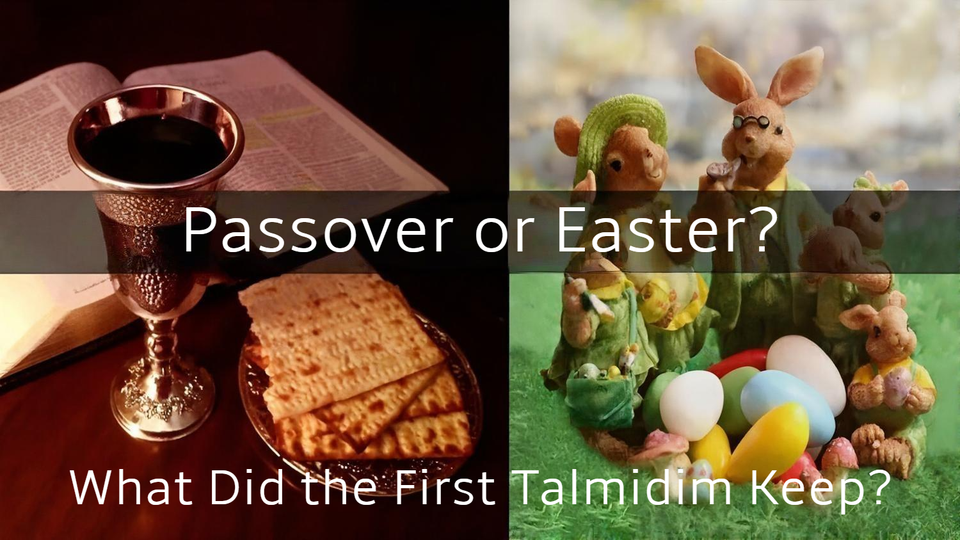
A Torah-True Examination of Pesach, Resurrection, and the Traditions of Men
Many believers have never paused long enough to ask whether Easter is truly a biblical observance.
They say they love Y'hoshua/Jesus. They believe in His death and resurrection. They want to honor Him. And because Easter has been handed down through churches, families, and cultures for generations, many assume it must be part of the faith once delivered to the first disciples 2000 years ago.
But talmidim (disciples) are not called to walk by assumption. We are called to test all things by the Word of Y’hovah.
That means this is not merely a discussion about preference, nostalgia, or inherited custom. It is a discussion about authority.
Did our Father Y’hovah appoint Easter?
Did Y’hoshua the Messiah keep Easter?
Did the first disciples observe Easter?
Or did they honor Pesach (Passover), together with the appointed times surrounding it?
When we search the Scriptures carefully, the answer becomes clear: the first talmidim did not keep Easter as a commanded holy day. They honored Pesach, Matzot, and the redemptive pattern of Y’hovah’s appointed times. Historically, Easter observance is attested by the 2nd century, and later disputes centered on how to date it in relation to Passover, showing that the issue developed after the apostolic period rather than being instituted by our Rabbi Gadol Y’hoshua in Scripture.
Pesach Was Appointed by Y’hovah
“And יהוה spoke unto Moses and Aaron in the land of Egypt, saying: ‘This month shall be unto you the beginning of months; it shall be the first month of the year to you. Speak ye unto all the congregation of Israel, saying: In the tenth day of this month they shall take to them every man a lamb, according to their fathers’ houses, a lamb for a household… And ye shall keep it against the fourteenth day of the same month; and the whole assembly of the congregation of Israel shall kill it at dusk. And they shall take of the blood, and put it on the two side-posts and on the lintel, upon the houses wherein they shall eat it. And they shall eat the flesh in that night, roast with fire, and unleavened bread; with bitter herbs they shall eat it… And thus shall ye eat it: with your loins girded, your shoes on your feet, and your staff in your hand; and ye shall eat it in haste—it is יהוה’S passover. For I will go through the land of Egypt in that night, and will smite all the first-born in the land of Egypt… and when I see the blood, I will pass over you, and there shall no plague be upon you to destroy you, when I smite the land of Egypt. And this day shall be unto you for a memorial, and ye shall keep it a feast to יהוה; throughout your generations ye shall keep it a feast by an ordinance for ever.’”
Shemoth (Exodus) 12:1–14, JPS 1917
And again:
“These are the appointed seasons of יהוה, even holy convocations, which ye shall proclaim in their appointed season. In the first month, on the fourteenth day of the month at dusk, is יהוה’s passover. And on the fifteenth day of the same month is the feast of unleavened bread unto יהוה; seven days ye shall eat unleavened bread. In the first day ye shall have a holy convocation; ye shall do no manner of servile work. But ye shall bring an offering made by fire unto יהוה seven days; in the seventh day is a holy convocation; ye shall do no manner of servile work.”
Wayyiqra (Leviticus) 23:4–8, JPS 1917
Pesach is not the invention of man. It is not a later religious preference. It is one of Y’hovah’s moedim (appointed times).
That means the first question is not, “Which holiday do I like better?” The first question is, “What did Y’hovah appoint?”
Messiah Y’hoshua Kept Pesach
“Then came the day of matzah, on which the Passover lamb had to be killed. Yeshua sent Kefa and Yochanan, instructing them, ‘Go and prepare our Seder, so we can eat.’ They asked him, ‘Where do you want us to prepare it?’ He told them, ‘As you are going into the city, a man carrying a jar of water will meet you. Follow him into the house he enters, and say to the owner of the house, “The rabbi says to you, ‘Where is the guest room, where I am to eat the Passover meal with my talmidim?’” He will show you a large room upstairs already furnished. Make the preparations there.’ They went and found things just as Yeshua had told them, and they prepared for the Seder meal.”
Luqas (Luke) 22:7–13, CJB
Then:
“When the time came, Yeshua and the emissaries reclined at the table, and he said to them, ‘I have really wanted so much to celebrate this Seder with you before I die! For I tell you, it is certain that I will not celebrate it again until it is given its full meaning in the Kingdom of God.’ Then, taking a cup of wine, he made the b’rakhah and said, ‘Take this and share it among yourselves. For I tell you that from now on, I will not drink the “fruit of the vine” until the Kingdom of God comes.’ Also, taking a piece of matzah, he made the b’rakhah, broke it, gave it to them and said, ‘This is my body, which is being given for you; do this in memory of me.’ He did the same with the cup after the meal, saying, ‘This cup is the New Covenant, ratified by my blood, which is being poured out for you.’”
Luqas (Luke) 22:14–20, CJB
Y’hoshua HaMashiach did not institute Easter. He kept Pesach. He stood within the Father’s appointed time and revealed its deepest meaning in Himself.
Messiah Is Our Pesach
“Your boasting is not good. Don’t you know the saying, ‘It takes only a little hametz to leaven a whole batch of dough’? Get rid of the old hametz, so that you can be a new batch of dough, because in reality you are unleavened. For our Pesach lamb, the Messiah, has been sacrificed. So let us celebrate the festival, not with leftover hametz, the hametz of wickedness and evil, but with the matzah of purity and truth.”
Qorintiyim Aleph (1 Corinthians) 5:6–8, CJB
Sha’ul does not say, “Messiah is our Easter.” He says, “our Pesach lamb, the Messiah, has been sacrificed.” And then he says, “let us celebrate the festival.”
That is fulfillment, not replacement.
Messiah the Firstfruits
“But as it is, the Messiah has in fact been raised from the dead, the firstfruits of those who have died. For since death came through a man, also the resurrection of the dead has come through a man. For just as in connection with Adam all die, so in connection with the Messiah all will be made alive. But each in his own order: the Messiah is the firstfruits; then those who belong to the Messiah, at the time of his coming; then the culmination, when he hands over the Kingdom to God the Father, after having put an end to every rulership, yes, to every authority and power.”
Qorintiyim Aleph (1 Corinthians) 15:20–24, CJB
And Torah had already established the pattern:
“Speak unto the children of Israel, and say unto them: When ye are come into the land which I give unto you, and shall reap the harvest thereof, then ye shall bring the sheaf of the first-fruits of your harvest unto the priest. And he shall wave the sheaf before יהוה, to be accepted for you; on the morrow after the sabbath the priest shall wave it.”
Wayyiqra (Leviticus) 23:10–11, JPS 1917
The resurrection of Rabbi Y’hoshua is not floating outside Torah. It is framed by Firstfruits. The moedim do not hide Mashiach. They reveal Him.
What Did the First Talmidim Actually Keep?
The first talmidim were Jewish followers of Y’hoshua living in the world of Torah, the feasts, and the covenant story of Yisrael. The apostolic writings continue to use Passover language, and the post-apostolic disputes were over how Pascha should be observed and dated, not over whether Easter had already been commanded by Y’hoshua.
Nowhere do the apostolic writings command talmidim to keep Easter. Nowhere do they establish Easter as a moed of Y’hovah. Nowhere do they show the emissaries replacing Pesach with a new church feast.
Acts 12:4 and the KJV Confusion
The KJV reads:
“And when he had apprehended him, he put him in prison, and delivered him to four quaternions of soldiers to keep him; intending after Easter to bring him forth to the people.”
Ma‘asei (Acts) 12:4, KJV
But the Greek word there is πάσχα (pascha), the standard New Testament word for Passover, and interlinear/lexical sources render Acts 12:4 accordingly.
So the KJV did not create Easter, because Easter observance long predates 1611. But the KJV became the dominant English Bible for centuries, and its use of “Easter” in Acts 12:4 helped reinforce the impression that Easter was present in the apostolic text. That is why it is fair to say the popular KJV helped fuel confusion in the English-speaking world, even though it did not originate the holiday itself.
Constantine, Nicaea, and the Separation from the Biblical Calendar
Here we need to be careful, truthful, and sober.
The Council of Nicaea in 325 A.D. was convened by Emperor Constantine and is best known for addressing the Arian controversy, but it also dealt with the Easter question and pushed for a unified observance across the churches. The broader Paschal controversies before and after Nicaea centered on whether believers should keep the feast on the 14th of Nisan in connection with Passover, or instead observe it on a Sunday according to a distinct church calculation.
What matters for this teaching is this: Nicaea helped formalize a movement toward independence from the Jewish calendar, and later Christian tradition increasingly treated that independence as a virtue. Britannica notes that one of the rules associated with the Nicene settlement was independence from the Jewish calendar, alongside worldwide uniformity.
That means the shift was not only about convenience. It was also about identity and separation.
And Constantine’s own surviving letter after the council makes that spirit painfully clear. In that letter, he urged the churches not to have anything in common with Jewish practice regarding the feast and argued that Christians had received a different way. Surviving translations of the letter preserve strongly anti-Jewish language, showing that hostility toward Jewish reckoning was part of the atmosphere around the decision.
So we should say this carefully:
Council of Nicaea did not create all Easter observance from nothing.
That development had already been underway for centuries.
But the Nicaean Council and the first Pope Constantine did help deepen and formalize the separation from the biblical calendar and from Jewish Passover reckoning. In that sense, they were a major turning point in the post-apostolic drift away from the Hebraic framework of the faith.
This matters because once the assembly of Messiah began treating separation from Jewish reckoning as spiritually desirable, the distance from Torah’s calendar became easier to justify.
A talmid should hear that and grieve.
Because the biblical calendar was not given by rabbinic invention. It was given by Y’hovah.
Tradition Grows Powerful When It Is Repeated, Not When It Is Proven
Y’hoshua HaMashiach warned:
“You have let go of the commands of God and are holding onto human traditions.”
Marqos (Mark) 7:8, CJB
And again:
“Thus, with your tradition which you had handed on to you, you nullify the Word of God! And you do other things like this.”
Marqos (Mark) 7:13, CJB
That warning speaks directly to this issue.
The wording gets repeated, and a custom becomes normal.
A historical shift gets sanctified. And after enough generations, people assume it must have come from the Bible.
But repetition is not revelation.
What About Eggs, Rabbits, and Sunrise Services?
Even if someone says, “I only care about the resurrection,” many common Easter customs are not rooted in Scripture. The apostolic writings do not command eggs, rabbits, or annual sunrise services as covenant memorials. These are later customs of men, not biblical appointments.
That does not mean every person using those customs intends evil. Many are simply inheriting what they were taught.
But a talmid (disciple) still must ask:
Did YHVH God command this?
Did our Messian model this?
Did the apostles teach this?
What Should a Disciple Do Today?
A talmid of Y’hoshua should honor the death, burial, and resurrection of Messiah within the framework Avinu Y’hovah Himself established:
- Pesach for the Lamb and redemption
- Matzot for separation from leaven and corruption
- Firstfruits for resurrection hope and harvest promise
This is not a call to arrogance. It is not a call to mock Christians.
It is a call to return.
Return to what Y’hovah appointed.
Return to the pattern Y’hoshua kept.
Return to the apostolic witness.
Return to TORAH (Scripture) over custom.
A Final Call Back to the Ancient Path
Passover is not a discarded shadow. Passover is one of Avinu Y’hovah’s appointed witnesses, and in Messiah it shines brighter than ever.
Messian Y’hoshua kept Pesach. Rabbi Sha’ul called Messiah our Pesach.
Messiah’s resurrection is revealed as Firstfruits.
Acts 12:4 says pascha, not Easter.
And the post-apostolic move toward a distinct Easter observance was shaped significantly by later controversies, by the Council of Nicaea’s push for uniformity, and by a deliberate distancing from Jewish calendar reckoning.
So the issue becomes plain:
TORAH (Scripture) gives us Pesach, Matzot, and Firstfruits.
Scripture does not give us Easter as a commanded feast.
For the talmid (disciple), that should settle the matter.
Let us then walk humbly, gently, and firmly — not boasting in knowledge, not despising those who have not yet seen, but returning with joy to the Moedim (appointments) of Avinu (our Father).
By Rabbi Francisco Arbas
📧 franciscoarbas.yisrael@gmail.com
Following His ‘WAY’ — Netzari Mashiach Judaism

Comments ()