Relationship Over Religion: Walking with Y’hovah Through His Word and Spirit
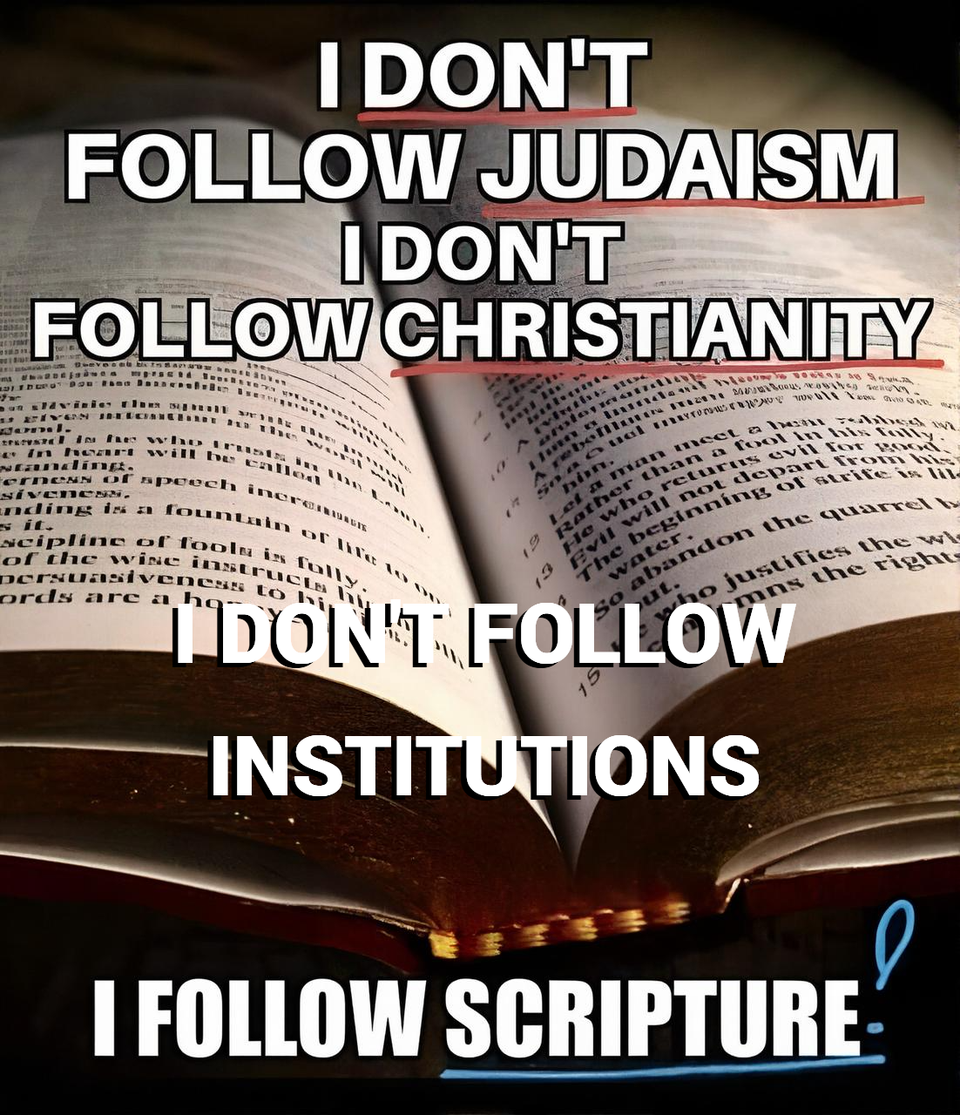
As talmidim (disciples) of Mashiach (Messiah), seeking clarity in our identity and emunah (faith), perhaps the most fundamental issue we face is not what we believe, but how we relate to Y’hovah our Father. Too often, we unconsciously revert to religion—mistaking systems, traditions, titles, and labels for a living covenantal relationship with the Elohim of Yisrael.
Many of us arrive in Messianic faith after rejecting institutional Christianity or Judaism, recognizing that something vital was missing. In that transition, we often assume that the next framework—Messianic Judaism, Hebraic Roots, Torah movement—must therefore be the way to reach Y’hovah. Yet without careful self-examination and teshuvah (repentance), we frequently exchange one form of religion for another, changing outward expressions while retaining the same religious impulse.
True discipleship, however, is not about replacing religious labels. It is about walking in obedience through the Ruach, guided by the Word of Y’hovah. His TORAH (instructions)!
Judaism as a Substitute for Relationship
Within the Messianic Jewish movement, the temptation often manifests as elevating Judaism itself to a sacred or salvific status. Traditions, halakhic frameworks, cultural identity, or linguistic precision can slowly become perceived as spiritual gateways—rather than tools to serve Scripture.
Some even assert that accepted forms of Judaism (Orthodox, Conservative, etc.) are necessary contexts for authentic Messianic faith. Others subtly treat Judaism as a parental authority, using it as validation for legitimacy or spiritual depth.
When this occurs, Judaism becomes the lens through which Scripture is interpreted, rather than Scripture standing as the supreme authority over every tradition.
“Do not add to the Word which I command you, nor take away from it, so as to guard the commands of יהוה your Elohim which I command you.”
— Devarim (Deuteronomy) 4:2, TS2009
Traditions may inform us, but Scripture must always govern us, as Rabbi Y'hoshua emphasized that human traditions should not override YHVH's commandments (Mattithyahu (Matthew) 15:3, 6). The Bible instructs disciples to hold firmly to traditions that align with YHVH's Word and are from examples that are in His Word, as Paul encouraged the Corinthians to do in (Qorintiyim Aleph (1 Corinthians) 11:2).
Is the Word Really Incomplete Without Religion?
Moshe directly challenges the idea that YHVH'S (God’s) Word requires religious intermediaries:
“For this mitzvah which I am giving you today is not too hard for you, it is not beyond your reach. It isn’t in the sky, so that you need to ask, ‘Who will go up into the sky for us, bring it to us and make us hear it, so that we can obey it?’ Likewise, it isn’t beyond the sea, so that you need to ask, ‘Who will cross the sea for us, bring it to us and make us hear it, so that we can obey it?’ On the contrary, the word is very close to you—in your mouth, even in your heart; therefore, you can do it!
— Deuteronomy 30:11–14, CJB
This is not an endorsement of isolated individualism, but a call to personal responsibility and relationship. Y’hovah expects His people to hear, trust, and obey His Word—not outsource obedience to religious systems or a form of religious duty.
As they retain the outer form of religion but deny its power. Stay away from these people!
Timotiyos Bĕt (2 Timothy) 3:5 (CJB)
Discipleship Through the Ruach and the Word
Authentic talmidut (discipleship) flows from relationship first, structure second. Scripture reveals that discipleship unfolds through:
Hearing the Word
Pride hardens our hearts, keeping Y'hovah’s Word from digging deep into our souls for transformation. His truth will correct us by His Ruach. His Word combats the lies of the enemy, leading us in love to greater abundance in the Ruach (Spirit).
Trust in יהוה with all your heart, And lean not on your own understanding; Know Him in all your ways, And He makes all your paths straight. Do not be wise in your own eyes; Fear יהוה and turn away from evil.
Mishlĕ (Proverbs) 3:5-6 (TS2009)
We lay down our own ideas and preferences, humbly admitting we need TORAH (His instructions) and truth.
Responding in obedience
Responding to YHVH's Word in obedience means you're actively listening to His teachings and applying them in your life with a willing heart. This reflects your trust in Y'hovah's authority and love for Him, as obedience is seen as an expression of faith and love.
The God of shalom brought up from the dead the great Shepherd of the sheep, our Lord Yeshua, by the blood of an eternal covenant.
May God equip you with every good thing you need to do his will; and may he do in us whatever pleases him, through Yeshua the Messiah. To him be the glory forever and ever. Amen.
Ivrim (Hebrews) 13:20–21 (CJB)
Walking daily by the Ruach
“But the Helper, the Ruach HaQodesh, whom the Father will send in My Name, He shall teach you all matters, and remind you of all that I said to you.”
— Yoḥanan (John) 14:26, TS2009
“For everyone led by the Spirit of God is a son of God.”
— Romans 8:14, CJB
The Ruach (Spirit) never contradicts the Word (TORAH)—and the Word was never meant to function apart from the Ruach. Religion severs this harmony by placing systems between the believer and Elohim.
Faith Cannot Be Engineered
Trusting/faith is being confident of what we hope for, convinced about things we do not see. It was for this that Scripture attested the merit of the people of old.
— Ivrim (Hebrews) 11:1, (CJB)
“And without belief it is impossible to please Elohim.”
— Ivrim (Hebrews) 11:6, TS2009
Religion seeks safety in religious rituals; faith requires a continuous commitment to surrender. Faith cannot be fenced, institutionalized, or controlled—it must remain responsive and obedient to YHVH's will. This active engagement helps keep one's faith vibrant and alive.
Scripture: An Open Book for the Humble
“The meek will He guide in justice; and the meek will He teach His way.”
— Tehillim (Psalm) 25:9, JPS 1917
“Be doers of the Word, and not hearers only, deceiving yourselves.”
— Ya‘aqob (James) 1:22, TS2009
“If you love me, you will keep my commands.”
— John 14:15, CJB
The Scriptures are not obscure; they are resisted. They are clear—but costly. True discipleship involves a commitment to follow Y'hoshua and obey His teachings, which can challenge personal religious beliefs and comfort. It requires self-denial and a willingness to embrace the high cost of living according to Scripture.
We do not reach Y’hovah through religion.
We reach Him through repentance, trust, obedience, humility, and a living relationship, cultivated through His Word, empowered by His Ruach, and revealed through our Rabbi Y’hoshua HaMashiach.
Simple? Yes.
And I fear that somehow your minds may be seduced away from simple and pure devotion to the Messiah, just as Havah was deceived by the serpent and his craftiness.
Qorintiyim Bĕt (2 Corinthians) 11:3 (CJB)
Easy? Never.
but it is a narrow gate and a hard road that leads to life, and only a few find it.
Mattithyahu (Matthew) 7:14 (CJB)
By Rabbi Francisco Arbas
📧 franciscoarbas.yisrael@gmail.com
Following His ‘WAY’ — Netzari Mashiach Judaism


Comments ()