WHEN THE VEIL IS TAKEN AWAY
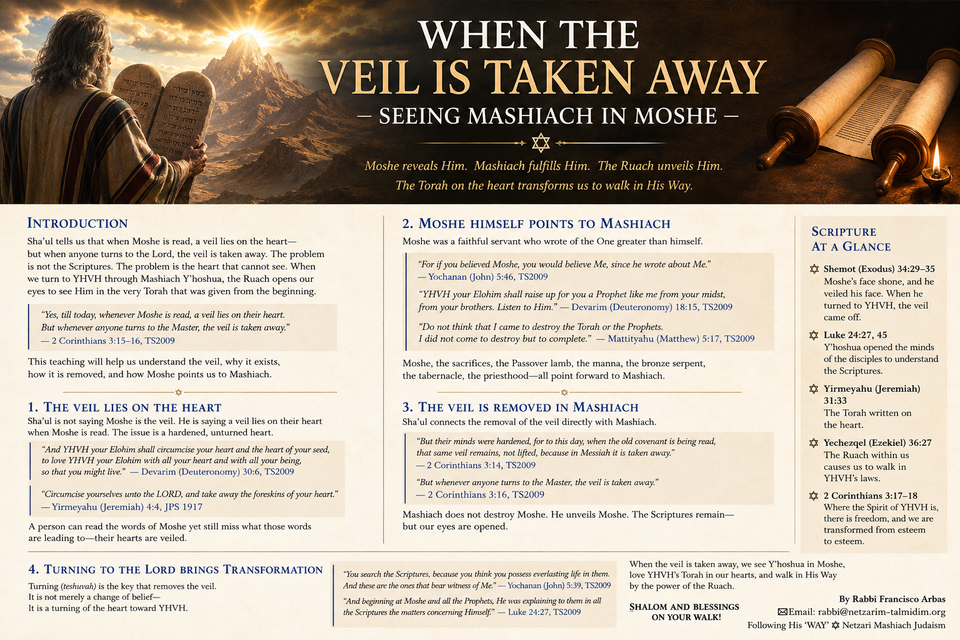
Seeing Mashiach in Moshe
“Yes, till today, whenever Moshe is read, a veil lies on their heart. And when one turns to the Master, the veil is taken away.”
— 2 Corinthians 3:15–16, TS2009
There is a profound difference between reading the Scriptures and seeing what the Scriptures reveal.
A person may know the words of Moshe, study the commandments, understand the history of Yisrael, and still fail to recognize the One toward whom the Torah and the Prophets are pointing.
Likewise, a person may profess faith in Y’hoshua HaMashiach while misunderstanding Moshe and assuming that Mashiach came to abolish the very Torah that bears witness concerning Him.
Sha’ul addresses this mystery in 2 Corinthians 3 through the image of a veil.
But we must begin with an important distinction:
Moshe is not the veil.
The Torah is not the veil.
The veil lies upon the heart.
When the heart turns to Y’hovah and recognizes His revelation in Y’hoshua HaMashiach, the veil is removed. The Scriptures themselves have not changed.
The eyes of the reader have been opened.
1. THE VEIL BEGINS WITH MOSHE
To understand Sha’ul, we must return to Shemot (Exodus) 34:29–35.
Moshe had been upon Mount Sinai in the presence of Y’hovah. When he descended carrying the tablets of the covenant, something extraordinary had happened:
“And it came to be, when Moshe came down from Mount Sinai, while the two tablets of the Witness were in Moshe’s hand when he came down from the mountain, that Moshe did not know that the skin of his face shone since he had spoken with Him.”
— Shemot (Exodus) 34:29, TS2009
Moshe's face reflected the glory of having been in the presence of Y’hovah.
Aharon and the children of Yisrael were afraid to approach him. After Moshe spoke to them, he placed a veil over his face.
Yet there is an important detail:
“But whenever Moshe went in before יהוה to speak with Him, he would remove the veil until he came out.”
— Shemot (Exodus) 34:34, TS2009
Notice the pattern.
Moshe turns toward Y’hovah — the veil comes off.
Centuries later, Sha’ul uses precisely this imagery:
“And when one turns to the Master, the veil is taken away.”
— 2 Corinthians 3:16, TS2009
This is not accidental.
Sha’ul is using Moshe's experience to describe a spiritual reality.
When the heart genuinely turns toward Y’hovah, what prevented spiritual sight is removed.
2. THE VEIL LIES UPON THE HEART
Sha’ul carefully tells us where the veil is located:
“Yes, till today, whenever Moshe is read, a veil lies on their heart.”
— 2 Corinthians 3:15, TS2009
He does not say:
“Moshe is the veil.”
He does not say:
“The Torah is the veil.”
He says:
“A veil lies on their heart.”
That changes how the entire passage should be understood.
The problem is not with Y’hovah's Torah.
The problem is the human heart.
This problem existed long before the first century.
Moshe himself spoke about it:
“And יהוה your Elohim shall circumcise your heart and the heart of your seed, to love יהוה your Elohim with all your heart and with all your being, so that you might live.”
— Devarim (Deuteronomy) 30:6, TS2009
Yirmeyahu later cried:
“Circumcise yourselves to the LORD, and take away the foreskins of your heart.”
— Yirmeyahu (Jeremiah) 4:4, JPS 1917
Y’hovah's people could possess Torah externally while resisting Him internally.
They could hear without hearing.
They could see without seeing.
They could read without understanding.
The veil therefore represents something much deeper than intellectual ignorance.
It speaks of spiritual blindness and hardness of heart.
3. MOSHE HIMSELF POINTS TO MASHIACH
Here we arrive at one of the most important statements Y’hoshua ever made concerning Moshe:
“For if you believed Moshe, you would believe Me, since he wrote about Me.”
— Yochanan (John) 5:46, TS2009
Think carefully about those words.
Y’hoshua did not say:
“Forget Moshe and follow Me.”
He said that properly believing Moshe should lead someone toward recognizing Him.
Why?
Because Moshe wrote about Mashiach.
One of the clearest examples is:
“YHVH your Elohim shall raise up for you a Prophet like me from your midst, from your brothers. Listen to Him.”
— Devarim (Deuteronomy) 18:15, TS2009
Moshe was pointing beyond himself.
The Torah was preparing Yisrael for something greater.
This principle extends throughout the Torah.
The Passover lamb points toward Mashiach.
The blood of deliverance points toward Mashiach.
The manna from heaven points toward Mashiach.
The bronze serpent lifted up in the wilderness points toward Mashiach.
The tabernacle points toward Mashiach.
The priesthood points toward Mashiach.
The sacrificial system points toward Mashiach.
The Day of Atonement points toward Mashiach.
Even Moshe himself, as mediator of the covenant, anticipates the greater work of Y’hoshua.
Therefore, when Y’hoshua says:
“For if you believed Moshe, you would believe Me…”
He is telling us something extraordinary:
You cannot fully understand Moshe without eventually encountering Mashiach.
4. MASHIACH DOES NOT DESTROY MOSHE — HE UNVEILS HIM
Sha’ul writes:
“But their minds were hardened, for to this day, when the old covenant is being read, that same veil remains, not lifted, because in Messiah it is taken away.”
— 2 Corinthians 3:14, TS2009
Notice what is removed.
Not Moshe.
Not righteousness.
Not Y’hovah's commandments.
The veil is removed.
Mashiach does not destroy Moshe.
Mashiach unveils Moshe.
This harmonizes perfectly with Y’hoshua's own declaration:
“Do not think that I came to destroy the Torah or the Prophets. I did not come to destroy but to complete.”
— Mattityahu (Matthew) 5:17, TS2009
Y’hoshua did not come to erase the revelation that came before Him.
He came as its fulfillment.
The tragedy Sha’ul describes is therefore not that someone reads Moshe.
The tragedy is that someone can read Moshe while failing to recognize the Mashiach to whom Moshe points.
5. BUT THERE IS ANOTHER VEIL WE MUST RECOGNIZE
There is another side of this matter that deserves serious consideration.
Some read Moshe without Mashiach.
Others attempt to follow Mashiach without Moshe.
Both approaches leave something hidden.
Much of Christianity has historically been taught to approach Torah as though it were primarily something from which believers needed to be liberated.
But Y’hoshua said:
“Do not think that I came to destroy the Torah or the Prophets.”
— Mattityahu (Matthew) 5:17, TS2009
Sha’ul likewise wrote:
“So that the Torah truly is set-apart, and the command set-apart, and righteous, and good.”
— Romans 7:12, TS2009
And again:
“Do we then nullify the Torah through the belief? Let it not be! On the contrary, we establish the Torah.”
— Romans 3:31, TS2009
Therefore, 2 Corinthians 3 cannot properly be used to teach:
“When someone comes to Mashiach, Torah is removed.”
Sha’ul says no such thing.
What is removed?
The veil.
One veil can prevent someone from seeing Y’hoshua in Moshe.
Another inherited theological assumption can prevent someone who professes Y’hoshua from seeing the continuing holiness, righteousness, and goodness of Y’hovah's instruction.
The Netzari way must reject both errors.
Moshe without Mashiach is incomplete sight.
Mashiach separated from Moshe is incomplete understanding.
The Scriptures present one continuous revelation of Y’hovah's redemptive purpose.
6. Y’HOSHUA OPENED THEIR UNDERSTANDING OF MOSHE
After Y’hoshua's resurrection, two talmidim were walking toward Emmaus.
They knew the Scriptures.
They knew the events surrounding Y’hoshua's death.
Yet they did not understand how everything fit together.
What did Y’hoshua do?
“And beginning at Moshe and all the Prophets, He was explaining to them in all the Scriptures the matters concerning Himself.”
— Luke 24:27, TS2009
This is one of the most important passages for understanding the relationship between Torah and Mashiach.
Y’hoshua did not lead His talmidim away from Moshe.
He led them through Moshe.
And suddenly they began seeing things that had been there all along.
Later we read:
“Then He opened their minds to understand the Scriptures.”
— Luke 24:45, TS2009
What changed?
Did the Torah change?
No.
Did the Prophets change?
No.
Their understanding changed.
Their eyes were opened.
The veil was being removed.
7. “WHENEVER ANYONE TURNS”
Now notice the beautiful language of 2 Corinthians 3:16:
“And when one turns to the Master, the veil is taken away.”
— 2 Corinthians 3:16, TS2009
The principle of turning is deeply rooted in the Tanakh.
This is the biblical concept of teshuvah — returning.
Moshe said:
“And you shall turn back to יהוה your Elohim and obey His voice…”
— Devarim (Deuteronomy) 30:2, TS2009
And:
“And you shall seek יהוה your Elohim from there, and shall find, when you search for Him with all your heart and with all your being.”
— Devarim (Deuteronomy) 4:29, TS2009
The removal of the veil therefore begins with more than intellectual study.
It begins with turning.
A heart turns toward Y’hovah.
Pride is surrendered.
Traditions are tested.
Preconceived doctrines are placed beneath Scripture.
The person begins asking:
“Y’hovah, what does Your Word actually say?”
That is the heart of the Berean and Netzari Karaite approach.
We do not ask Scripture to conform to our theology.
We allow our theology to be corrected by Scripture.
8. THE RENEWED COVENANT WRITES TORAH UPON THE HEART
This becomes even clearer when we examine the promise of the renewed covenant.
Yirmeyahu prophesied:
“I will put My law in their inward parts, and in their heart will I write it; and I will be their God, and they shall be My people.”
— Yirmeyahu (Jeremiah) 31:33, JPS 1917
The renewed covenant does not promise the removal of Y’hovah's Torah.
It promises something far more powerful.
Torah moves from stone to heart.
That is precisely the language Sha’ul uses at the beginning of 2 Corinthians 3:
“You are our letter, having been written in our hearts, known and read by all men, making it obvious that you are a letter of Messiah, served by us, written not with ink but by the Spirit of the living Elohim, not on tablets of stone but on fleshly tablets of the heart.”
— 2 Corinthians 3:2–3, TS2009
This is not the abolition of Torah.
This is internalization.
Y’hovah's instruction is no longer merely something written before us.
Through His Ruach, it becomes something written within us.
9. THE RUACH DOES NOT LEAD US AWAY FROM TORAH
Sha’ul continues:
“Now יהוה is the Spirit, and where the Spirit of יהוה is, there is freedom.”
— 2 Corinthians 3:17, TS2009
This verse is frequently interpreted as freedom from Torah.
But does Scripture define the work of the Ruach that way?
Consider Y’hovah's promise through Yechezqel:
“And I shall put My Spirit within you, and I shall cause you to walk in My laws and guard My right-rulings and shall do them.”
— Yechezqel (Ezekiel) 36:27, TS2009
That is extraordinarily clear.
The Ruach does not lead Y’hovah's people away from His ways.
The Ruach empowers them to walk in His ways.
Therefore, the freedom of 2 Corinthians 3 is not freedom to rebel against Y’hovah.
It is freedom from the bondage that prevented us from truly obeying Him.
Freedom from sin.
Freedom from condemnation.
Freedom from spiritual blindness.
Freedom from hardened hearts.
Freedom from the flesh's domination.
Freedom to become what Y’hovah intended His people to be.
10. THE TORAH BEARS WITNESS OF Y’HOSHUA
Y’hoshua told the religious leaders:
“You search the Scriptures, because you think you possess everlasting life in them. And these are the ones that bear witness of Me.”
— Yochanan (John) 5:39, TS2009
The Scriptures bear witness.
But a witness must be heard.
Someone can possess a Bible, study Hebrew, memorize Torah, observe Shabbat, celebrate the moedim, and still miss the One toward whom those things testify.
Religious knowledge alone cannot remove the veil.
At the same time, someone may repeatedly say the name “Jesus,” attend church every week, and still know very little about the Jewish Rabbi Y’hoshua revealed throughout the Scriptures.
This is why we must return to the whole TORAH — all Scripture.
When the veil is removed, we begin seeing one continuous story.
Bereshit points forward.
Moshe points forward.
The Prophets point forward.
The Psalms point forward.
The moedim point forward.
The sacrificial pattern points forward.
And ultimately they converge upon Y’hoshua HaMashiach, the promised One of Yisrael.
11. THE PASSOVER LAMB — MASHIACH IN MOSHE
Consider Pesach.
In Shemot 12, Yisrael was commanded to take a lamb without blemish, slaughter it, and place its blood upon the doorposts.
Judgment passed over the houses marked by blood.
Centuries later Sha’ul writes:
“For also Messiah our Passover was slaughtered for us.”
— 1 Corinthians 5:7, TS2009
Mashiach did not make Pesach meaningless.
Mashiach revealed its prophetic depth.
The pattern existed in Moshe.
The fullness becomes visible in Y’hoshua.
Once the veil is removed, we see both together.
12. THE SERPENT IN THE WILDERNESS — MASHIACH IN MOSHE
When fiery serpents struck Yisrael in the wilderness, Y’hovah instructed Moshe to lift up a bronze serpent.
Those who looked upon it lived.
Y’hoshua later said:
“And as Moshe lifted up the serpent in the wilderness, even so the Son of Adam has to be lifted up.”
— Yochanan (John) 3:14, TS2009
Again:
Moshe points toward Mashiach.
The event was historical, but it also contained prophetic meaning that would become clearer in Y’hoshua.
13. THE MANNA — MASHIACH IN MOSHE
Yisrael received bread from heaven in the wilderness.
Y’hoshua later declared:
“I am the bread of life.”
— Yochanan (John) 6:48, TS2009
And He specifically connected His teaching to the manna their fathers ate in the wilderness.
The pattern repeats:
Moshe gives the shadow and pattern.
Mashiach reveals its fullness.
This does not diminish Moshe.
It shows how profoundly Y’hovah had embedded His redemptive purpose within the Torah from the beginning.
14. “A PROPHET LIKE UNTO ME”
Moshe himself declared:
“YHVH your Elohim shall raise up for you a Prophet like me from your midst, from your brothers. Listen to Him.”
— Devarim (Deuteronomy) 18:15, TS2009
Kefa later applied this passage directly to Y’hoshua:
“For Moshe truly said to the fathers, ‘יהוה your Elohim shall raise up for you a Prophet like me from your brothers. Him you shall hear according to all matters, whatever He says to you.’”
— Acts 3:22, TS2009
Moshe himself tells Yisrael:
Someone is coming. Listen to Him.
Thus, recognizing Y’hoshua is not abandoning Moshe.
It is taking Moshe seriously.
15. THE VEIL IS REMOVED FOR TRANSFORMATION
Sha’ul concludes this section with one of the most beautiful statements in the passage:
“And we all, as with unveiled face we see as in a mirror the esteem of יהוה, are being transformed into the same likeness from esteem to esteem, as from יהוה, the Spirit.”
— 2 Corinthians 3:18, TS2009
The removal of the veil has a purpose.
It is not merely so that we can win theological arguments.
It is not merely so that we can understand prophecy.
It is not merely so that we can possess better doctrine.
The veil is removed so that we may be transformed.
When we truly see Y’hovah's purpose revealed through His Dabar made flesh in Y’hoshua HaMashiach, we cannot remain unchanged.
The Torah becomes more than commandments upon a page.
Mashiach becomes more than a theological doctrine.
The Ruach begins writing Y’hovah's ways upon the heart.
And the talmid begins walking differently.
16. FROM STONE — TO HEART — TO LIFE
Look at the beautiful progression.
At Sinai:
The commandments were written upon stone.
Through Yirmeyahu:
Y’hovah promised to write His Torah upon the heart.
Through Yechezqel:
Y’hovah promised His Ruach would cause His people to walk in His statutes.
Through Y’hoshua:
The Torah is demonstrated in a perfectly obedient life.
Through the renewed covenant:
The talmid becomes a living letter of Mashiach.
This is not Torah abolished.
This is Torah lived.
This is what Y’hovah desired from the beginning.
17. TWO VEILS — ONE CALL TO RETURN
There is a warning here for all of us.
The Jewish reader must be willing to ask:
“Do I see Y’hoshua in Moshe?”
The Christian reader must be willing to ask:
“Do I see Moshe in the teachings and life of Y’hoshua?”
And all of us must ask:
“Am I reading Scripture through inherited traditions, or am I allowing Scripture to speak for itself?”
Y’hoshua did not come to create a religion separated from the faith of Avraham, Yitzhak, Ya’akov, Moshe, and the Prophets.
He came as the promised Mashiach of Yisrael.
Likewise, Torah observance without the transformation of the heart is insufficient.
The answer is not Torah versus Mashiach.
The biblical picture is:
Torah pointing toward Mashiach.
Mashiach revealing Torah's fullness.
The Ruach writing Y’hovah's ways upon the heart.
And the talmid walking in obedience because he loves Y’hovah.
WHEN THE VEIL IS TAKEN AWAY
Perhaps now we can hear Sha’ul's words differently:
“Yes, till today, whenever Moshe is read, a veil lies on their heart. And when one turns to the Master, the veil is taken away.”
— 2 Corinthians 3:15–16, TS2009
The problem was never Moshe.
The problem was the veil.
The answer was never abandoning Torah.
The answer was turning to Y’hovah.
Through True and Full Repentance, Immersion, and Receiving the Ruach
Entrance into the Kingdom of Avinu Y'hovah and removing the veil begins with three inseparable steps:
- Teshuvah (Repentance): Turning completely from sin and submitting to Y’hovah’s authority.
- Tevilah (Immersion/Baptism): Being immersed on the authority of Y’hoshua HaMashiach for the forgiveness of sins.
- Receiving the Ruach HaKodesh (Holy Spirit): The divine indwelling that seals and empowers each talmid as part of the Body of Mashiach.
Through obedience to Y’hoshua’s command in Yochanan [John] 3:7 and its fulfillment in Acts 2:38, we become reborn — renewed by Spirit and cleansed by the water of the Word.
And when the heart turns, something beautiful happens.
We begin seeing Y’hoshua in Moshe.
We begin seeing Moshe through Y’hoshua.
We begin understanding the Torah not merely as ancient commandments, but as part of Y’hovah's unfolding revelation and redemptive plan.
And through the Ruach HaKodesh, Y’hovah begins writing His ways upon our hearts.
The veil comes down.
The eyes open.
The Scriptures come alive.
And the talmid begins to see the WAY that had been there from the beginning.
“Then He opened their minds to understand the Scriptures.”
— Luke 24:45, TS2009
By Francisco Arbas
📜Email: rabbi@netzarim-talmidim.org
Following His ‘WAY’ ✡ Netzari Mashiach Judaism
May that be our prayer:
Avinu Y’hovah, remove every veil from our hearts. Open our understanding to Your TORAH. Help us to see Y’hoshua HaMashiach throughout Your Word. Circumcise our hearts, fill us with Your Ruach, and write Your ways within us so that we may not merely read Your Word—but walk in it.
Amein.
Comments ()