Y’hoshua HaMashiach; The Promised One of Yisrael
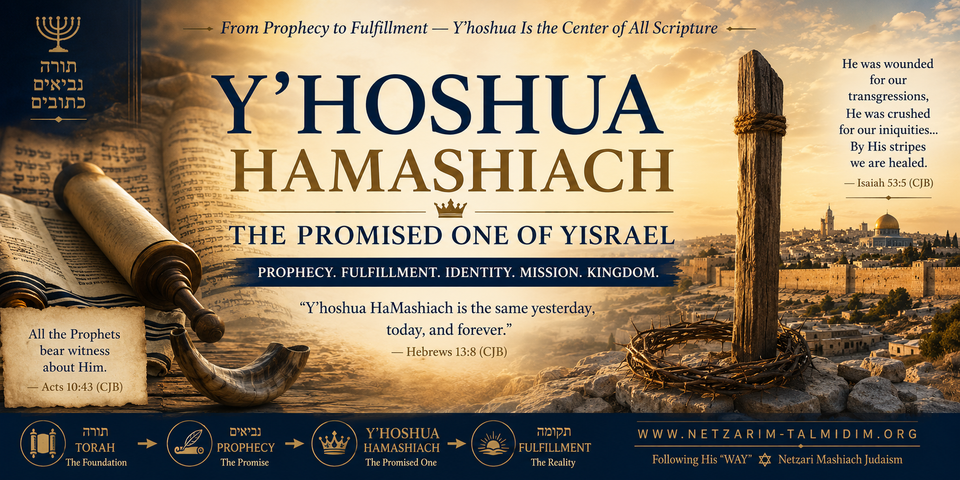
The coming of HaMashiach was not an afterthought. It was not invented by the talmidim, the early believers, or later religious systems. The promise of Mashiach is woven throughout the Tanakh, from the seed promised in Berĕshith (Genesis), to the prophet like Moshe in Devarim (Deuteronomy), to the suffering servant in Yeshayahu (Isaiah), to the King of Tsiyon in Tehillim (Psalms) and Zekaryah (Zechariah).
Y’hoshua Himself taught that the Scriptures testify concerning Him.
“You search the Scriptures, because you think that in them you possess everlasting life. And these are the ones that bear witness of Me.”
Yoḥanan (John) 5:39 — TS2009
For Netzari Mashiach Judaism, this matters deeply. We do not begin with religious tradition and then force Scripture to support it. We begin with the written TORAH — all Scripture as Y’hovah’s instruction — and allow the Word of Y’hovah to reveal the identity, mission, suffering, sacrifice, resurrection, priesthood, and Kingdom of Y’hoshua HaMashiach.
The question is not merely: “Were some predictions fulfilled?”
The greater question is:
Does Y’hoshua match the full prophetic portrait of HaMashiach revealed in the Tanakh?
The answer is YES.
Part One: His Identity
Who Is HaMashiach?
1. HaMashiach Would Be the Seed of the Woman
Prophecy — Tanakh
“And I will put enmity between thee and the woman, and between thy seed and her seed; they shall bruise thy head, and thou shalt bruise their heel.”
Berĕshith (Genesis) 3:15 — JPS 1917
Fulfillment — Renewed Covenant Witness
Y’hoshua defeats the work of the serpent through His obedience, death, and resurrection.
“For this purpose the Son of Elohim was manifested: to destroy the works of the devil.”
Yoḥanan Aleph (1 John) 3:8 — TS2009
Explanation
This is the first great promise of redemption after the fall. Y’hovah declares that the seed of the woman would crush the serpent’s head, though He Himself would be wounded. This points forward to Mashiach’s suffering and victory.
Y’hoshua was wounded, but He was not defeated. Through His death and resurrection, He broke the authority of sin and death and opened the way back to Avinu Y’hovah and the tree of life.
2. HaMashiach Would Be the Seed of Avraham
Prophecy — Tanakh
“And in thy seed shall all the nations of the earth be blessed; because thou hast hearkened to My voice.”
Berĕshith (Genesis) 22:18 — JPS 1917
Fulfillment — Renewed Covenant Witness
“And to your Seed, who is Messiah.”
Galatiyim (Galatians) 3:16 — TS2009
Explanation
The promise to Avraham was never only tribal or national in a narrow sense. Through Avraham’s seed, all nations would be blessed. This does not erase Yisrael. It confirms Yisrael’s calling as the vessel through whom Y’hovah’s redemptive blessing reaches the nations.
Y’hoshua HaMashiach is the promised Seed through whom that blessing comes.
3. HaMashiach Would Come from the Tribe of Y'hudah
Prophecy — Tanakh
“The sceptre shall not depart from Judah, nor the ruler’s staff from between his feet, as long as men come to Shiloh; and unto him shall the obedience of the peoples be.”
Berĕshith (Genesis) 49:10 — JPS 1917
Fulfillment — Renewed Covenant Witness
“For it is perfectly clear that our Master arose from Yehuḏah…”
Ivrim (Hebrews) 7:14 — TS2009
Explanation
The royal line was prophetically connected to Y'hudah. HaMashiach would not arise from just any tribe. He would come from the tribe associated with kingship, rulership, and the obedience of the peoples.
Y’hoshua fulfills this tribal expectation.
4. HaMashiach Would Be the Son of David
Prophecy — Tanakh
“And thy house and thy kingdom shall be made sure for ever before thee; thy throne shall be established for ever.”
Shĕmu’ĕl Bĕt (2 Samuel) 7:16 — JPS 1917
Fulfillment — Renewed Covenant Witness
“The book of the genealogy of יהושע Messiah, Son of Dawid, Son of Aḇraham.”
Mattithyahu (Matthew) 1:1 — TS2009
Explanation
The title “Son of David” is not a decorative phrase. It is a Messianic title. Y’hovah promised David an enduring throne, and the expectation of a Davidic King became central to Yisrael’s hope.
Y’hoshua is repeatedly identified as Son of David because He carries the royal promise of the Davidic covenant.
5. HaMashiach Would Be Born in Bethlehem
Prophecy — Tanakh
“But thou, Beth-lehem Ephrathah, which art little to be among the thousands of Judah, out of thee shall one come forth unto Me that is to be ruler in Israel; whose goings forth are from of old, from ancient days.”
Mikhah (Micah) 5:1 [5:2 English] — JPS 1917
Fulfillment — Renewed Covenant Witness
Y’hoshua was born in Beth-Leḥem of Y'hudah.
“And they said to him, ‘In Beth-lehem of Yehudah…’”
Mattithyahu (Matthew) 2:5 — TS2009
Explanation
Bethlehem was not chosen by accident. It was the city of David. The promised ruler of Yisrael would come from this humble place, showing again Y’hovah’s pattern: He brings greatness out of what men often overlook.
6. HaMashiach Would Be Born as a Divine Sign
Prophecy — Tanakh
“Therefore the Lord Himself shall give you a sign: behold, the young woman shall conceive, and bear a son, and shall call his name Immanuel.”
Yeshayahu (Isaiah) 7:14 — JPS 1917
Fulfillment — Renewed Covenant Witness
Mattithyahu identifies the birth of Y’hoshua as the fulfillment of this sign.
“See, an ‘almah’ shall conceive, and she shall give birth to a Son, and they shall call His Name Immanu’ĕl,” which translated, means, “Ěl with us.”
Mattithyahu (Matthew) 1:23 — TS2009
Explanation
The JPS 1917 renders the Hebrew as “young woman,” while the Renewed Covenant witness emphasizes the miraculous nature of the birth. The point is that Y’hovah Himself gives the sign.
“Immanuel” means that through Mashiach, Y’hovah is with His people in a unique and redemptive way.
7. HaMashiach Would Be Called the Son of Elohim
Prophecy — Tanakh
“I will tell of the decree: the LORD said unto me: ‘Thou art My son, this day have I begotten thee.’”
Tehillim (Psalms) 2:7 — JPS 1917
Fulfillment — Renewed Covenant Witness
“This is My Son, the Beloved, in whom I did delight.”
Mattithyahu (Matthew) 3:17 — TS2009
Explanation
“Son of Elohim” must be understood through Hebrew covenant categories, not pagan mythology. It speaks of divine appointment, royal authority, covenant sonship, and a unique relationship with Avinu Y’hovah.
Y’hoshua is the Son who perfectly represents the Father’s will, words, authority, and mission.
8. HaMashiach Would Be a Prophet Like Moshe
Prophecy — Tanakh
“The LORD thy God will raise up unto thee a prophet from the midst of thee, of thy brethren, like unto me; unto him ye shall hearken.”
Devarim (Deuteronomy) 18:15 — JPS 1917
Fulfillment — Renewed Covenant Witness
Kefa applies this prophecy to Y’hoshua.
“יהוה your Elohim shall raise up for you a Prophet like me…”
Ma‘asei (Acts) 3:22 — TS2009
Explanation
Moshe was deliverer, teacher, mediator, and covenant servant. Y’hoshua fulfills this pattern in its highest form. He teaches the true meaning of TORAH, delivers from bondage, mediates covenant relationship, and commands the people of Y’hovah to hear and obey.
This is why discipleship matters. If Y’hoshua is the Prophet like Moshe, then His talmidim must listen to Him.
9. HaMashiach Would Be the King of Yisrael
Prophecy — Tanakh
“Yet I have set My king upon Zion, My holy mountain.”
Tehillim (Psalms) 2:6 — JPS 1917
Fulfillment — Renewed Covenant Witness
“Rabbi, You are the Son of Elohim! You are the Sovereign of Yisra’ĕl!”
Yoḥanan (John) 1:49 — TS2009
Explanation
Our Rabbi Y’hoshua Ben Y'hovah is not merely a moral teacher or religious reformer. He is the appointed King of Yisrael. His authority is not Roman, Greek, denominational, or man-made. It comes from Avinu Y’hovah the Master.
His Kingdom is already present spiritually among His talmidim, and it will be fully established in the coming Millennial Kingdom.
10. HaMashiach Would Be the Branch
Prophecy — Tanakh
“And there shall come forth a shoot out of the stock of Jesse, and a twig shall grow forth out of his roots.”
Yeshayahu (Isaiah) 11:1 — JPS 1917
Fulfillment — Renewed Covenant Witness
“He shall be called a Natsarene.”
Mattithyahu (Matthew) 2:23 — TS2009
Explanation
The Branch imagery points to the Davidic hope — a living shoot from what appeared cut down. Y’hoshua is the promised growth from the root of Yishai.
This also connects beautifully with the Netzari identity. We are followers of the Nazarene, the Branch, the One through whom Y’hovah brings restoration.
Part Two: His Mission
What Would HaMashiach Do?
11. HaMashiach Would Be a Light to the Nations
Prophecy — Tanakh
“I the LORD have called thee in righteousness, and have taken hold of thy hand, and kept thee, and set thee for a covenant of the people, for a light of the nations.”
Yeshayahu (Isaiah) 42:6 — JPS 1917
Fulfillment — Renewed Covenant Witness
“I am the light of the world.”
Yoḥanan (John) 8:12 — TS2009
Explanation
Y’hoshua does not bring the nations into a new Gentile religion separated from Yisrael, called Christianity. He brings the nations into the light of Y’hovah, the Elohim of Yisrael.
This is restoration, not replacement.
12. HaMashiach Would Open Blind Eyes and Release Captives
Prophecy — Tanakh
“To open the blind eyes, to bring out the prisoners from the dungeon, and them that sit in darkness out of the prison-house.”
Yeshayahu (Isaiah) 42:7 — JPS 1917
Fulfillment — Renewed Covenant Witness
Y’hoshua healed the blind, delivered the oppressed, and released those bound by darkness.
“And blind and lame ones came to Him… and He healed them.”
Mattithyahu (Matthew) 21:14 — TS2009
Explanation
The miracles of Y’hoshua were not random demonstrations of power. They were signs that the Messianic mission had arrived. The King was restoring what sin, sickness, darkness, and oppression had damaged.
13. HaMashiach Would Preach Good News to the Poor
Prophecy — Tanakh
“The spirit of the Lord GOD is upon me; because the LORD hath anointed me to bring good tidings unto the humble; He hath sent me to bind up the broken-hearted, to proclaim liberty to the captives, and the opening of the eyes to them that are bound.”
Yeshayahu (Isaiah) 61:1 — JPS 1917
Fulfillment — Renewed Covenant Witness
Y’hoshua read this passage in the synagogue and applied it to His mission.
“Today this Scripture has been filled in your hearing.”
Luqas (Luke) 4:21 — TS2009
Explanation
The Good News is not lawlessness. The Good News is the announcement that our Father Y’hovah’s redemption, forgiveness, healing, restoration, and Kingdom are arriving through HaMashiach.
Y’hoshua came to restore people back to Avinu Y’hovah.
14. HaMashiach Would Minister in Galilee
Prophecy — Tanakh
“The people that walked in darkness have seen a great light; they that dwelt in the land of the shadow of death, upon them hath the light shined.”
Yeshayahu (Isaiah) 9:1 [9:2 English] — JPS 1917
Fulfillment — Renewed Covenant Witness
Mattithyahu connects Y’hoshua’s Galilean ministry with Yeshayahu’s prophecy.
“The people who sat in darkness saw a great light…”
Mattithyahu (Matthew) 4:16 — TS2009
Explanation
Galilee was often looked down upon, yet Y’hovah chose that region for the light of Mashiach’s ministry. Once again, Y’hovah exalts the humble and reaches those whom religious pride often overlooks.
15. HaMashiach Would Teach in Parables
Prophecy — Tanakh
“I will open my mouth with a parable; I will utter dark sayings concerning days of old.”
Tehillim (Psalms) 78:2 — JPS 1917
Fulfillment — Renewed Covenant Witness
“All these יהושע spoke to the crowds in parables…”
Mattithyahu (Matthew) 13:34 — TS2009
Explanation
Y’hoshua’s parables revealed truth to the humble while exposing the hardness of those who refused to hear. Parables were not cute religious stories. They were Kingdom teachings that separated hearers from doers.
16. HaMashiach Would Be Zealous for Y’hovah’s House
Prophecy — Tanakh
“Because zeal for Thy house hath eaten me up, and the reproaches of them that reproach Thee are fallen upon me.”
Tehillim (Psalms) 69:10 [69:9 English] — JPS 1917
Fulfillment — Renewed Covenant Witness
“The ardour for Your house has eaten Me up.”
Yoḥanan (John) 2:17 — TS2009
Explanation
When Y’hoshua cleansed the Temple courts, He was not rejecting the Temple. He was defending the holiness of His Father’s house.
That is important. HaMashiach was not anti-Torah, anti-Jewish, or anti-Temple. He was against corruption, hypocrisy, and the misuse of holy things.
In modern terms, He was not flipping tables because He had anger issues. He was flipping tables because men had turned worship into business. Sometimes restoration comes with sawdust and flying coins, 😊 Rabbi.
17. HaMashiach Would Enter Yerushalayim on a Donkey
Prophecy — Tanakh
“Rejoice greatly, O daughter of Zion, shout, O daughter of Jerusalem; behold, thy king cometh unto thee; he is triumphant, and victorious, lowly, and riding upon an ass, even upon a colt the foal of an ass.”
Zekaryah (Zechariah) 9:9 — JPS 1917
Fulfillment — Renewed Covenant Witness
“See, your Sovereign comes to you, meek, and sitting on a donkey…”
Mattithyahu (Matthew) 21:5 — TS2009
Explanation
Y’hoshua entered Yerushalayim as the humble King. He did not come the first time as a military conqueror riding a warhorse, but as the righteous King offering peace, repentance, and restoration.
Part Three: His Rejection and Suffering
How Would HaMashiach Be Treated?
18. HaMashiach Would Be Rejected by His Own
Prophecy — Tanakh
“He was despised, and forsaken of men, a man of pains, and acquainted with disease, and as one from whom men hide their face: he was despised, and we esteemed him not.”
Yeshayahu (Isaiah) 53:3 — JPS 1917
Fulfillment — Renewed Covenant Witness
“He came to His own, and His own did not receive Him.”
Yoḥanan (John) 1:11 — TS2009
Explanation
Many rejected Y’hoshua because He did not fit their expectations. They wanted deliverance from Rome, but He came first to deliver from sin. They wanted national restoration, but He began with heart restoration.
The true Mashiach often offends man-made expectations.
19. HaMashiach Would Be the Rejected Stone
Prophecy — Tanakh
“The stone which the builders rejected is become the chief corner-stone.”
Tehillim (Psalms) 118:22 — JPS 1917
Fulfillment — Renewed Covenant Witness
Y’hoshua applied this directly to Himself.
“The stone which the builders rejected has become the chief corner-stone…”
Mattithyahu (Matthew) 21:42 — TS2009
Explanation
The builders were those who should have recognized the stone. Yet they rejected the very One Y’hovah chose as the foundation.
This is a warning to every generation: religious authority must still bow to Scripture.
20. HaMashiach Would Be Betrayed by a Close Companion
Prophecy — Tanakh
“Yea, mine own familiar friend, in whom I trusted, who did eat of my bread, hath lifted up his heel against me.”
Tehillim (Psalms) 41:10 [41:9 English] — JPS 1917
Fulfillment — Renewed Covenant Witness
Yehudah from Qerioth betrayed Y’hoshua after sharing table fellowship with Him.
“He who eats bread with Me has lifted up his heel against Me.”
Yoḥanan (John) 13:18 — TS2009
Explanation
The betrayal was not merely political. It was personal. One who walked near Him betrayed Him. This reveals the pain of Mashiach and the danger of outward closeness without inward faithfulness.
21. HaMashiach Would Be Betrayed for Thirty Pieces of Silver
Prophecy — Tanakh
“And I said unto them: ‘If ye think good, give me my hire; and if not, forbear.’ So they weighed for my hire thirty pieces of silver.”
Zekaryah (Zechariah) 11:12 — JPS 1917
Fulfillment — Renewed Covenant Witness
“And they counted out to him thirty pieces of silver.”
Mattithyahu (Matthew) 26:15 — TS2009
Explanation
The exact betrayal price was foretold. Thirty pieces of silver was associated with the valuation of a slave. HaMashiach was treated with contempt by men, yet honored by Y’hovah.
22. The Betrayal Money Would Be Cast into the House of Y’hovah
Prophecy — Tanakh
“And the LORD said unto me: ‘Cast it into the treasury, the goodly price that I was prized at of them.’ And I took the thirty pieces of silver, and cast them into the treasury, in the house of the LORD.”
Zekaryah (Zechariah) 11:13 — JPS 1917
Fulfillment — Renewed Covenant Witness
The betrayal money was returned and used in connection with the potter’s field.
“And throwing down the pieces of silver… he left.”
Mattithyahu (Matthew) 27:5 — TS2009
Explanation
Even the handling of the betrayal money became part of the prophetic witness. Men acted according to their own motives, yet Y’hovah’s Word stood firm.
23. HaMashiach Would Be Silent Before His Accusers
Prophecy — Tanakh
“He was oppressed, though he humbled himself and opened not his mouth; as a lamb that is led to the slaughter, and as a sheep that before her shearers is dumb; yea, he opened not his mouth.”
Yeshayahu (Isaiah) 53:7 — JPS 1917
Fulfillment — Renewed Covenant Witness
“But יהושע remained silent.”
Mattithyahu (Matthew) 26:63 — TS2009
Explanation
Y’hoshua did not defend Himself through pride, rage, or manipulation. He submitted to the will of Avinu Y’hovah. His silence was not weakness. It was obedience.
24. The Shepherd Would Be Struck and the Sheep Scattered
Prophecy — Tanakh
“Awake, O sword, against My shepherd, and against the man that is near unto Me, saith the LORD of hosts; smite the shepherd, and the sheep shall be scattered…”
Zekaryah (Zechariah) 13:7 — JPS 1917
Fulfillment — Renewed Covenant Witness
“I shall strike the Shepherd, and the sheep of the flock shall be scattered.”
Mattithyahu (Matthew) 26:31 — TS2009
Explanation
The scattering of the talmidim was painful, but not unexpected. Scripture had already revealed it. Their failure also shows the mercy of Y’hovah, because after the resurrection Y’hoshua restored and recommissioned them.
25. HaMashiach Would Be Numbered with Transgressors
Prophecy — Tanakh
“Therefore will I divide him a portion among the great, and he shall divide the spoil with the mighty; because he bared his soul unto death, and was numbered with the transgressors…”
Yeshayahu (Isaiah) 53:12 — JPS 1917
Fulfillment — Renewed Covenant Witness
Y’hoshua was executed between criminals.
“And with Him they impaled two robbers…”
Marqos (Mark) 15:27 — TS2009
Explanation
The Righteous One was counted among the guilty. This reveals the humility of HaMashiach and His willingness to identify with sinners in order to redeem them.
26. HaMashiach’s Hands and Feet Would Be Pierced
Prophecy — Tanakh
“For dogs have compassed me; a company of evil-doers have inclosed me; like a lion, they are at my hands and my feet.”
Tehillim (Psalms) 22:17 [22:16 English] — JPS 1917
Fulfillment — Renewed Covenant Witness
Y’hoshua was impaled, and after His resurrection He showed His wounds.
“See My hands and My feet, that it is I Myself.”
Luqas (Luke) 24:39 — TS2009
Explanation
Tehillim 22 gives a vivid picture of suffering. While textual discussions exist around the wording of this verse, the broader Psalm clearly matches the suffering pattern seen in Y’hoshua: public mockery, exposed suffering, divided garments, and deliverance by Y’hovah.
27. HaMashiach Would Be Mocked
Prophecy — Tanakh
“All they that see me laugh me to scorn; they shoot out the lip, they shake the head.”
Tehillim (Psalms) 22:8 [22:7 English] — JPS 1917
Fulfillment — Renewed Covenant Witness
“And those passing by were blaspheming Him, shaking their heads…”
Mattithyahu (Matthew) 27:39 — TS2009
Explanation
The public humiliation of Y’hoshua was part of His suffering. Yet He endured the shame faithfully, trusting Avinu Y’hovah.
28. The People Would Say, “Let Y’hovah Deliver Him”
Prophecy — Tanakh
“‘Let him commit himself unto the LORD! let Him rescue him; let Him deliver him, seeing He delighteth in him.’”
Tehillim (Psalms) 22:9 [22:8 English] — JPS 1917
Fulfillment — Renewed Covenant Witness
“He trusted in Elohim, let Him rescue Him now…”
Mattithyahu (Matthew) 27:43 — TS2009
Explanation
The mockers unknowingly echoed the prophetic pattern. What they meant as insulting became testimony.
29. Soldiers Would Divide His Garments
Prophecy — Tanakh
“They part my garments among them, and for my vesture do they cast lots.”
Tehillim (Psalms) 22:19 [22:18 English] — JPS 1917
Fulfillment — Renewed Covenant Witness
“They divided His garments, casting lots…”
Yoḥanan (John) 19:24 — TS2009
Explanation
Even the actions of Roman soldiers became part of the witness. They did not intend to fulfill Scripture, yet they did.
Y’hovah’s Word does not depend on man’s awareness to be fulfilled.
30. HaMashiach Would Be Given Vinegar to Drink
Prophecy — Tanakh
“Yea, they put poison into my food; and in my thirst they gave me vinegar to drink.”
Tehillim (Psalms) 69:22 [69:21 English] — JPS 1917
Fulfillment — Renewed Covenant Witness
“They gave Him sour wine mixed with bile to drink…”
Mattithyahu (Matthew) 27:34 — TS2009
Explanation
The bitterness offered to Y’hoshua points to the suffering and rejection He endured. Even His thirst became part of the prophetic witness.
31. HaMashiach Would Be Pierced
Prophecy — Tanakh
“And I will pour upon the house of David, and upon the inhabitants of Jerusalem, the spirit of grace and of supplication; and they shall look unto Me because they have thrust him through; and they shall mourn for him, as one mourneth for his only son…”
Zekaryah (Zechariah) 12:10 — JPS 1917
Fulfillment — Renewed Covenant Witness
“One of the soldiers pierced His side with a spear…”
Yoḥanan (John) 19:34 — TS2009
Explanation
Y’hoshua was pierced, and the prophetic word of Zekaryah points toward a future recognition and mourning connected to the house of David and Yerushalayim.
This prophecy is not exhausted by the execution scene alone. It also points forward to Yisrael’s future awakening and recognition of HaMashiach.
Part Four: His Sacrifice
Why Did HaMashiach Suffer?
32. HaMashiach Would Be Like a Lamb Led to Slaughter
Prophecy — Tanakh
“He was oppressed, though he humbled himself and opened not his mouth; as a lamb that is led to the slaughter…”
Yeshayahu (Isaiah) 53:7 — JPS 1917
Fulfillment — Renewed Covenant Witness
“See, the Lamb of Elohim who takes away the sin of the world!”
Yoḥanan (John) 1:29 — TS2009
Explanation
Y’hoshua is identified as the Lamb of Elohim. This connects His mission to sacrifice, deliverance, atonement, and redemption.
33. HaMashiach Would Be Our Pesach Sacrifice
Prophecy — Tanakh
“Your lamb shall be without blemish, a male of the first year; ye shall take it from the sheep, or from the goats.”
Shemoth (Exodus) 12:5 — JPS 1917
Fulfillment — Renewed Covenant Witness
“For also Messiah our Pĕsaḥ was offered for us.”
Qorintiyim Aleph (1 Corinthians) 5:7 — TS2009
Explanation
Y’hoshua is our Pesach. This does not remove the Torah foundation — it reveals it. The Pesach lamb in Shemoth pointed to deliverance from bondage and protection from judgment. Y’hoshua fulfills that redemptive pattern in its highest meaning.
He is not a replacement for Y’hovah’s appointed times. He is the center and fulfillment of what they teach.
34. None of His Bones Would Be Broken
Prophecy — Tanakh
“In one house shall it be eaten; thou shalt not carry forth aught of the flesh abroad out of the house; neither shall ye break a bone thereof.”
Shemoth (Exodus) 12:46 — JPS 1917
Also:
“He keepeth all his bones; not one of them is broken.”
Tehillim (Psalms) 34:21 [34:20 English] — JPS 1917
Fulfillment — Renewed Covenant Witness
“They did not break His legs.”
Yoḥanan (John) 19:33 — TS2009
Explanation
The soldiers broke the legs of others, but not Y’hoshua’s. This preserved the Pesach pattern: no bone of the lamb was broken.
35. HaMashiach Would Bear Our Sins
Prophecy — Tanakh
“But he was wounded because of our transgressions, he was crushed because of our iniquities: the chastisement of our welfare was upon him, and with his stripes we were healed.”
Yeshayahu (Isaiah) 53:5 — JPS 1917
Fulfillment — Renewed Covenant Witness
“He Himself bore our sins in His body…”
Kefa Aleph (1 Peter) 2:24 — TS2009
Explanation
Y’hoshua’s suffering was not meaningless tragedy. He bore sin so that we might be restored to righteousness.
This is important: His sacrifice does not give permission for continued rebellion. His sacrifice delivers us from sin so we can walk in obedience, healing, and covenant relationship with Y’hovah.
36. HaMashiach Would Make Intercession for Transgressors
Prophecy — Tanakh
“…yet he bore the sin of many, and made intercession for the transgressors.”
Yeshayahu (Isaiah) 53:12 — JPS 1917
Fulfillment — Renewed Covenant Witness
“Ever living to make intercession for them.”
Ivrim (Hebrews) 7:25 — TS2009
Explanation
Y’hoshua does not only die as a sacrifice. He lives as the intercessor. His ministry continues before Avinu Y’hovah.
This moves us from sacrifice into priesthood.
37. HaMashiach Would Be Buried with the Rich
Prophecy — Tanakh
“And they made his grave with the wicked, and with the rich his tomb; although he had done no violence, neither was any deceit in his mouth.”
Yeshayahu (Isaiah) 53:9 — JPS 1917
Fulfillment — Renewed Covenant Witness
Yoseph of Ramathayim, a rich man and talmid, placed Y’hoshua’s body in his own tomb.
“There came a rich man from Ramathayim, named Yoseph…”
Mattithyahu (Matthew) 27:57 — TS2009
Explanation
Y’hoshua was executed among criminals, yet buried with honor. This fulfilled the paradox of Yeshayahu 53: rejected by men, yet righteous before Y’hovah.
Part Five: His Resurrection and Victory
Would HaMashiach Remain in the Grave?
38. HaMashiach Would Rise from the Dead
Prophecy — Tanakh
“For Thou wilt not abandon my soul to the nether-world; neither wilt Thou suffer Thy godly one to see the pit.”
Tehillim (Psalms) 16:10 — JPS 1917
Fulfillment — Renewed Covenant Witness
“He is not here, for He was raised…”
Mattithyahu (Matthew) 28:6 — TS2009
Explanation
The resurrection is not a side doctrine. It is central to the testimony of HaMashiach. Y’hovah did not abandon His Set-Apart One to the grave.
The resurrection confirms Y’hoshua’s identity, vindicates His obedience, and declares victory over death.
39. HaMashiach Would Ascend on High
Prophecy — Tanakh
“Thou hast ascended on high, Thou hast led captivity captive; Thou hast received gifts among men, yea, among the rebellious also, that the LORD God might dwell there.”
Tehillim (Psalms) 68:19 [68:18 English] — JPS 1917
Fulfillment — Renewed Covenant Witness
“He was taken up, and a cloud hid Him…”
Ma‘asei (Acts) 1:9 — TS2009
Explanation
Y’hoshua’s resurrection is followed by His ascension. He is not merely alive again on earth; He is exalted by Y’hovah.
40. HaMashiach Would Sit at the Right Hand of Y’hovah
Prophecy — Tanakh
“A Psalm of David. The LORD saith unto my lord: ‘Sit thou at My right hand, until I make thine enemies thy footstool.’”
Tehillim (Psalms) 110:1 — JPS 1917
Fulfillment — Renewed Covenant Witness
“He… sat down at the right hand of Elohim.”
Marqos (Mark) 16:19 — TS2009
Explanation
The right hand speaks of authority, honor, and exaltation. HaMashiach reigns under the authority of Avinu Y’hovah and awaits the full subduing of His enemies.
This is Kingdom language.
Part Six: His Priesthood and Covenant Work
What Is HaMashiach Doing Now?
41. HaMashiach Would Be Priest According to Malki-Tzedek
Prophecy — Tanakh
“The LORD hath sworn, and will not repent: ‘Thou art a priest for ever after the manner of Melchizedek.’”
Tehillim (Psalms) 110:4 — JPS 1917
Fulfillment — Renewed Covenant Witness
“You are a priest forever according to the order of Malkitseḏeq.”
Ivrim (Hebrews) 5:6 — TS2009
Explanation
Y’hoshua is not only King; He is also Priest. His priesthood is not based on the Levitical order, but on the order of Malki-Tzedek — king of righteousness and king of peace.
This explains how Y’hoshua can serve as heavenly intercessor and mediator.
42. HaMashiach Would Establish the Renewed Covenant
Prophecy — Tanakh
“Behold, the days come, saith the LORD, that I will make a new covenant with the house of Israel, and with the house of Judah.”
Yirmeyahu (Jeremiah) 31:30 [31:31 English] — JPS 1917
Fulfillment — Renewed Covenant Witness
“This cup is the renewed covenant in My blood…”
Luqas (Luke) 22:20 — TS2009
Explanation
The Renewed Covenant is not made with a lawless Gentile church replacing Yisrael. Yirmeyahu says it is made with the house of Yisrael and the house of Yehudah.
Through Y’hoshua, the nations are invited into covenant blessing, but they do not replace the root.
43. HaMashiach Would Write TORAH on the Heart
Prophecy — Tanakh
“But this is the covenant that I will make with the house of Israel after those days, saith the LORD, I will put My law in their inward parts, and in their heart will I write it; and I will be their God, and they shall be My people.”
Yirmeyahu (Jeremiah) 31:32 [31:33 English] — JPS 1917
Fulfillment — Renewed Covenant Witness
The Renewed Covenant work of the Ruach writes Y’hovah’s instruction upon the heart.
“I shall put My laws into their mind…”
Ivrim (Hebrews) 8:10 — TS2009
Explanation
The Renewed Covenant does not abolish TORAH. It internalizes TORAH. The problem was never Y’hovah’s instruction. The problem was the human heart.
Through HaMashiach and the Ruach HaQodesh, Y’hovah transforms the heart so His people can walk in obedience.
Part Seven: His Kingdom
What Will HaMashiach Establish?
44. HaMashiach Would Rule the Nations
Prophecy — Tanakh
“Ask of Me, and I will give the nations for thine inheritance, and the ends of the earth for thy possession.”
Tehillim (Psalms) 2:8 — JPS 1917
Fulfillment — Renewed Covenant Witness
“All authority has been given to Me in heaven and on earth.”
Mattithyahu (Matthew) 28:18 — TS2009
Explanation
Y’hoshua’s authority is universal. He is King of Yisrael, and His rule extends to the nations. The nations are not called to erase Yisrael’s identity, but to submit to the King appointed by Y’hovah.
45. HaMashiach’s Kingdom Would Be Everlasting
Prophecy — Tanakh
“And there was given him dominion, and glory, and a kingdom, that all the peoples, nations, and languages should serve him; his dominion is an everlasting dominion, which shall not pass away, and his kingdom that which shall not be destroyed.”
Dani’ĕl (Daniel) 7:14 — JPS 1917
Fulfillment — Renewed Covenant Witness
“He shall reign… forever, and there shall be no end to His reign.”
Luqas (Luke) 1:33 — TS2009
Explanation
The Kingdom of HaMashiach is not temporary, symbolic only, or dependent on human governments. It is everlasting. This is why our hope is not ultimately in politics, nations, or religious institutions.
Our hope is in the coming reign of Y’hoshua HaMashiach.
46. HaMashiach Would Bring Shalom
Prophecy — Tanakh
“For a child is born unto us, a son is given unto us; and the government is upon his shoulder; and his name is called Pele-joez-el-gibbor-Abi-ad-sar-shalom.”
Yeshayahu (Isaiah) 9:5 [9:6 English] — JPS 1917
Fulfillment — Renewed Covenant Witness
“Peace I leave with you, My peace I give to you…”
Yoḥanan (John) 14:27 — TS2009
Explanation
Y’hoshua brings shalom first to the heart through reconciliation with Y’hovah (You must be born again). But that shalom will also be fully manifested in His coming Kingdom.
The world cannot manufacture true shalom because true shalom comes only through submission to the rule of Y’hovah and His appointed King.
47. HaMashiach Would Come Again in Glory
Prophecy — Tanakh
“And His feet shall stand in that day upon the mount of Olives, which is before Jerusalem on the east…”
Zekaryah (Zechariah) 14:4 — JPS 1917
Fulfillment — Renewed Covenant Witness
“This same יהושע… shall come in the same way…”
Ma‘asei (Acts) 1:11 — TS2009
Explanation
The story is not finished. Y’hoshua came first in humility, suffering, and sacrifice. He will return in power, glory, judgment, restoration, and Kingdom authority.
The talmidim of Y’hoshua must live ready.
Final Thoughts
The Full Prophetic Portrait of Y’hoshua HaMashiach
When we examine the prophetic witness of the Tanakh, we do not see a thin or shallow picture. We see a complete portrait.
HaMashiach would be:
The Seed of the woman.
The Seed of Avraham.
From Yehudah.
Son of David.
Born in Bethlehem.
Called Son of Elohim.
A Prophet like Moshe.
The King of Yisrael.
The Branch.
A Light to the nations.
A healer, deliverer, and restorer.
Rejected by His own.
Betrayed.
Mocked.
Pierced.
Numbered with transgressors.
The Lamb of Elohim.
Our Pesach sacrifice.
The bearer of sin.
The intercessor for transgressors.
Raised from the dead.
Ascended on high.
Seated at the right hand of Y’hovah.
Priest according to Malki-Tzedek.
Mediator of the Renewed Covenant.
King over Yisrael and the nations.
The coming ruler of the everlasting Kingdom.
This is why Y’hoshua HaMashiach cannot be reduced to a religious symbol, a Christianized invention, or a Romanized figure detached from His Hebrew identity.
He is the Promised One of Yisrael.
He is the One spoken of by the Prophets.
He is the One revealed through TORAH.
He is the One the talmidim followed.
And He is the One we must follow today.
To confess Y’hoshua as HaMashiach is not merely to agree with a doctrine. It is to become His talmid — to hear His voice, obey His teaching, walk in His steps, and live in covenant faithfulness to Avinu Y’hovah.
By Francisco Arbas
📜Email: rabbi@netzarim-talmidim.org
Following His ‘WAY’ ✡ Netzari Mashiach Judaism

Comments ()